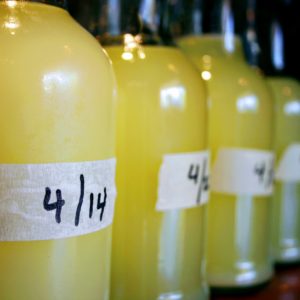
Inspired by a visit to see Tony Conigliaro at the unnamed bar at 69 Colebrooke Row in London last fall, where Manhattans are aged in glass vessels to sublime and subtle effect, the barrel aged cocktails I’ve been serving at Clyde Common this year are a decidedly American curiosity.
The rub of aging cocktails in a glass bottle is that the whole premise is built upon subtlety, as we know that spirits aged in glass or steel do so at an unremarkable pace. Being from the United States, where – as everyone is aware – bigger equals better, I pondered the following question: what if you could prepare a large batch of a single, spirit-driven cocktail and age it in a used oak barrel?
A hundred some-odd dollars in liquor later, I was nervously pouring a gallon of pre-batched rye Manhattans into a small, used oak cask whose previous contents were a gallon Madeira wine. I plugged the barrel and sat back in anxious anticipation; if the experiment was a success I’d have a delicious cocktail to share at the bar – if it was a failure then I’d be pouring the restaurant’s money down the floor drain.
Over the next several weeks I popped open the barrel to test my little concoction until I stumbled upon the magic mark at five-to-six weeks. And there it was, lying beautifully on the the finish: a soft blend of oak, wine, caramel and char. That first batch sold out in a matter of days and I was left with a compelling need to push the process even further.
Now, three gallons of Negroni might not be practical for the home enthusiast, but the average bar or restaurant should be able to afford that sort of quantity quite easily. For those of you trying this at home, try searching the internet for one-gallon charred oak casks (stay away from the fancy lacquered kind meant for display in dens and 1980s wine bars) and be sure to let us know what you find in the comments section below.
We procured a small number of used whiskey casks from the Tuthilltown distillery and proceeded to fill them with a large batch of Negronis; and that’s when the magic of barrel aged cocktails grabbed our attention. After six weeks in the bourbon barrel, our Negroni emerged a rare beauty. The sweet vermouth so slightly oxidized, the color paler and rosier than the original, the mid-palate softly mingled with whiskey, the finish long and lingering with oak tannins. We knew we were on to something unique and immediately made plans to take the cask aging program to the next level.
Negronis are now prepared in five-gallon batches and poured into multiple bourbon barrels. Robert Hess’ ubiquitous Trident cocktail is currently resting inside single-malt barrels. The El Presidente (à laMatt Robold), Deshlers, Remember the Maines, they’re all receiving the oaked treatment in a little storage room in the basement of the restaurant that I refer to as my “office”.
Once the cocktail is aged long enough for my taste, I then drain the bottle, straining out any charred bits of wood, and bottle the contents for use by my bartenders. To order, the cocktail is then measured out and poured over ice in a mixing glass, stirred, strained into a cocktail glass, and then garnished with the appropriate garnish. It’s quick and simple, as all of the real work has already been done by the barrel.
Anyway, on to the recipes. As simple as it seems to do, I figured not everyone is going to want to do the math to get started on some of these recipes, so here are a few I’ve figured out:
Negroni
Makes Three Gallons
128 oz (approximately five 750ml bottles) dry gin
128 oz sweet vermouth
128 oz Campari
Stir ingredients together (without ice) and pour into a three-gallon oak barrel. Let rest for five to seven weeks and pour into glass bottles until ready to serve.
Manhattan
Makes Three Gallons
256 oz (approximately ten 750ml bottles) rye whiskey
128 oz (approximately five 750ml bottles) sweet vermouth
7 oz Angostura bitters
Stir ingredients together (without ice) and pour into a three-gallon oak barrel (I prefer a barrel that has previously stored sherry, Madeira, or port wine). Let rest for five to seven weeks and pour into glass bottles until ready to serve.
Trident
Makes Three Gallons
128 oz (approximately five 750ml bottles) aquavit
128 oz dry sherry
128 oz Cynar
7 oz peach bitters
Stir ingredients together (without ice) and pour into a three-gallon oak barrel (I prefer a used single malt barrel). Let rest for five to seven weeks and pour into glass bottles until ready to serve.
Feel free to leave any questions in the comments section below.
My problem with homemade tonic water has always been a flavor profile that was too esoteric for the general audience. This recipe takes some of the positive qualities people have come to understand from commercial tonic water and updated them with fresh ingredients.
One question I'm often asked is "Do you have any drink-related book recommendations?" Well, funny you should ask, I've compiled a list of the ten books every professional bartender or home mixologist should own. I keep every one of these close at hand and have read most of them several times. I suggest you do the same.
The problem with living in Oregon is the absence of little wooden shacks by the sea that sell cases of fresh ginger beer stacked on back porches. But with some readily-available ingredients, a recipe I've been revising for several years - and a few free minutes - I can easily transport myself to a little fishing boat on the ocean as I sip a Dark and Stormy made with fresh, house-made ginger beer.
It's always mojito season somewhere, so this advice is timely in your area about half the year. Wether you're making them or simply enjoying them, this advice will help you look like a pro in no time at all.
The flavors of the Richmond Gimlet are imbued with sunshine. Fresh mint mingling with the herbaceousness of gin and the tartness of lime have made this drink a Eugene classic for many years now.
You'll get a lot of snarky advice on this site about how to make a proper drink, but if you ever need to know what not to do, this is the video for you.
Not to be confused with the Spanish wine-and-fruit-based alcoholic beverage sangria, sangrita (meaning "little blood") is a traditional accompaniment to a tequila served completo; a non-alcoholic sipper that cleanses the palate between fiery doses of agave.
The world of booze can be mystifying to people that don't work in bars or around alcohol all the time. I hear a lot of assumptions about the industry I'm in that are - much like 90% of what you hear in bars - completely false. Here are a few you've probably heard yourself.
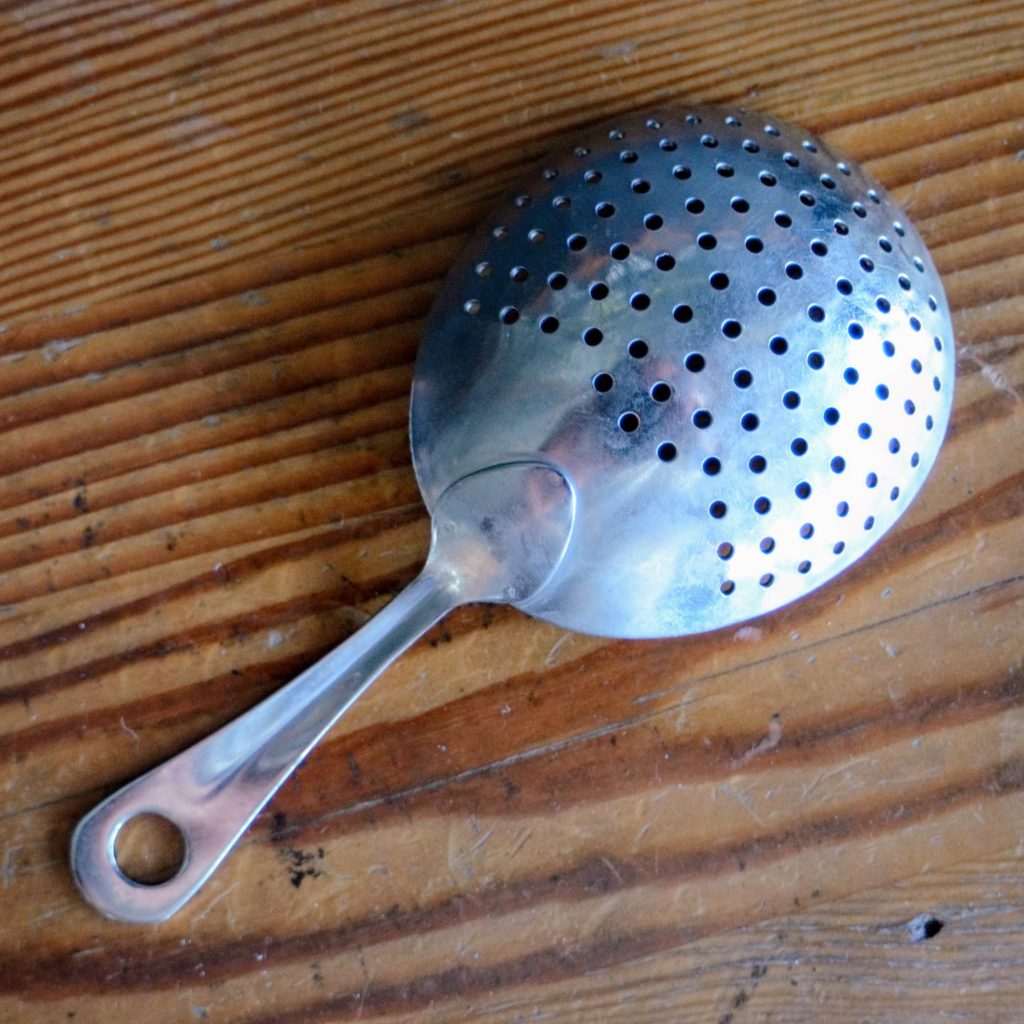
The debate rages on: Should we try to look cool and crack open the Boston shaker or be tidy professionals and use the Hawthorne strainer the way God intended? Be sure to leave your two cents in the comments section.
The traditional garnish for a Pisco Sour is a couple of drops of bitters in the foam, but I've never been particularly impressed with the way these few paltry drops of bitters sat in their little egg-white mattress and didn't play along with the rest of the drink. I envisioned a Pisco Sour with a uniformly-distributed bitters-scorched foam: slightly crisp as the fire burnt the sugars, and slightly warm as the foam insulated the rest of the frosty cocktail from the heat. A pisco creme brulée in a glass!
I get so many visitors looking for tips on how to write a bartending resume that I thought I should finally post a tutorial on how to write your own. Click the headline to read more.
I always love showing up to a party with a gallon jug of pre-mixed margaritas, so I've decided to share my recipe. This margarita recipe is the perfect blend of strong, sweet, and sour. But be warned: this recipe packs a serious punch.
There isn't much I can say about this video that hasn't been said already. If you've read anything I've written about cocktails, you'll understand why this video symbolizes everything wrong with the state of bartending in America today. Watch and learn, but be warned: this one isn't for the feint of heart.
About Me
My name is Jeff Morgenthaler and I'm the head bartender at Clyde Common in Portland, Oregon.
I've been tending bar since 1996 and writing about it since 2004. Mixing drinks has become something of a passion for me in recent years, and I strive to elevate the experience of having a drink from something mundane to something more culinary.
The writing I do here is intended as a work in progress. My recipes are like my opinions: they are constantly being revised and refined as I work them through my mind and my fingers. Comments and participation are encouraged, so please don't feel the need to tread lightly here.
I’m a big fan of Jamie Boudreau’s website Spirits and Cocktails. The writing is engaging, the photography is brilliant, and his techniques push the boundaries of mixology. So when I read about how Jamie would brulée brandied cherries with a Misto filled with 151-proof rum and Angostura bitters, I was inspired.
And I immediately thought: this sounds like a perfect treatment for the Pisco Sour.
You see, a Pisco Sour is made with egg white, and shaking the hell out of the drink creates a thick, foamy head on the cocktail. And while the traditional garnish for a Pisco Sour is a couple of drops of bitters in the foam, but I’ve never been particularly impressed with the way these few paltry drops of bitters sat in their little egg-white mattress and didn’t play along with the rest of the drink.
So when I read about Jamie taking the old Angostura flamethrower to his drinks, I envisioned a Pisco Sour with a uniformly-distributed bitters-scorched foam: slightly crisp as the fire burnt the sugars, and slightly warm as the foam insulated the rest of the frosty cocktail from the heat. A pisco creme brulée in a glass!
Although I had some great test-runs with the 151, I was missing the intensity I was looking for. Jamie wrote and suggested I try Stroh 80, which is 160-proof rum that has a distinct aroma of butterscotch and packs a wallop of alcoholic punch which is well-suited to lighting things on fire (thanks, Jamie!)
Anyway, I won’t bother you with a Pisco Sour recipe at this time, especially since so many others have written about such matters more eloquently than I could hope to do. What I’m going to do is show you how I scorch my Pisco Sour foam. And yes, this is on the menu at El Vaquero.
First off, grab yourself a Misto. You can find them just about anywhere you find kitchen supplies. And don’t get the vermouth sprayer, get yourself the Big Boy.
Next, fill your Misto with two ounces of Angostura bitters and two ounces of Stroh 80 rum. Cap your Misto and shake to mix the two ingredients. Pump your sprayer full of air and get ready to get pyrotechnic.
** Disclaimer: You’re about to spray a stream of flammable liquid toward an open flame. Be careful, and don’t point it at anyone or anything other than the cocktail. You could seriously harm yourself or others, so don’t be a dick.
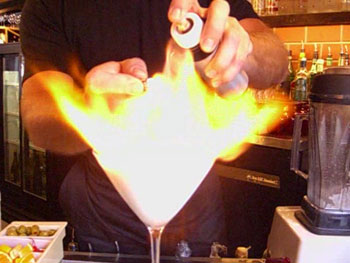
Light a match or strike up a lighter about 4 inches from the top of your already-prepared Pisco Sour. Carefully spray your Misto toward the drink, through the open flame, burning the top of the drink. Here, watch this:
When you’re done, the foam should look something like this:
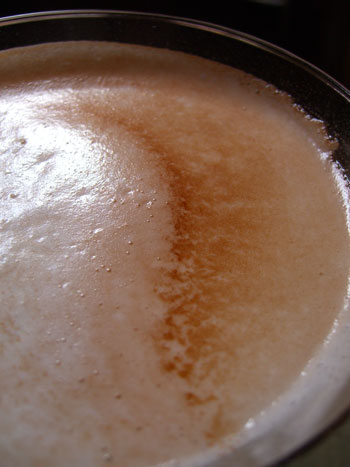
The fire will really open up the aromatics in the Anogstura, and when served immediately, the foam will be a real treat for the senses. It’s been a big hit at the bar these past few weeks, so grab a Misto and try it for yourself!

Comments
27 Responses to “How to Make an Angostura-Scorched Pisco Sour”
I’ve wanted to do something similar since I read about Baristas serving coffee drinks with bruleed foam toppings. Why should coffee jerks get all the fun?
Using the Angostura flamethrower on a Pisco Sour is genius!
You are killing me! I ran up to the Golden Gate Bridge, and I threw my boston shaker into the San Francisco Bay. I quit. THIS is the coolest thing I have ever seen.
I like fire as much as the next guy, Jeffrey, but I do think that, as cool as this is, it misses the point of the bitters in the Pisco Sour. The way I see it, it’s all about aromatic subtlety, with the few drops of bitters providing an olfactory addition to the flavour of the drink. And since we all taste more with our sense of smell than we do with our actual tastebuds, the bitters are playing with the rest of the drink, just in a different manner than if they were shaken into the Sour.
Or to put it all in beer terms, the traditional Pisco Sour is a dry-hopped British best bitter, while your creme brulée version is a west coast IPA.
First things first, the bitters of a Pisco sour should always be on TOP of the sour, not mixed within. The reason for this is as Stephen says; olfactory pleasure. Passing angostura through flame (or cooking any Indian spices)really enhances it’s aroma and flavor, therefore acheiving in a more effecient manner the perfumed purpose of bitters in a Pisco Sour.
Jeffrey, try using the “brulee” with “molecular” foams as well. They actually brulee, and you have the addition of aromatized bitters as well as a “cooked” foam, which adds more aroma but also slightly changes the flavor of the foam. I use to do this a couple of years back when I was at Lumiere, to fantastic effect.
Now, that, is f’ing brilliant. Thanks for trying out the technique, and I’m glad you guys are enjoying it. I might have to come hang out at the Bellagio sooner than February!
Cheers,
Jeff
31 Aug 2007 at 5:19 pm 15. Ali
I really need to spend more time reading your articles.
As you know I like anything that adds a little flair behind the bar!
This is a good one.
02 Sep 2007 at 3:47 am 16. John Claude
We’re getting Pisco and Stroh in our next liquor order and I just bought a Misto off of Amazon. Can’t wait to pull this one out on the patrons.
Very cool. Tried it out last night. My pisco sour recipe needs some adjustment, but the scorched top was a treat. Thanks for posting!
13 Sep 2007 at 2:40 pm 18. Keith
I just picked up a Misto to try this as well. How much would you like to wager there was a distict spike in Misto sales after you posted this GENIUS idea?
I tried this with the Pisco and with one of my own drinks that has a Campari and Strawberry honey foam and it was nice..real nice, but i haven`t yet managed to get that nice pattern on the foam as you have. I more get a bruleed color..maybe i should burn a bit closer? or use a different spirit,i used Angostura and LH 151.
Tiare – I got the flamethrower idea from Jamie B., he recommended using Stroh 80 for a little extra heat.
09 Mar 2009 at 1:15 pm 22. Derek
Would love to try it, but a bit concerned about the danger factor. anyone think it would be less risky to use just a regular, non-pressurized, sprayer? Would this reduce the effectiveness of the technique?
Derek – While I can’t speak for the safety of either method, I can say that I’d imagine it to be equally effective. Give it a shot and let us know.
16 Mar 2009 at 2:03 pm 24. Derek
Am i reading this right? 2oz of bitters? Isn’t that like half the bottle? Looking forward to trying this (just realized I still have an unopened misto i got as a gift 5 years ago), but wanted to double check this before I empty the entire bottle, drop by drop.
BTW, was great to meet you! (We stopped by Clyde Common friday night, visiting from SF. After trying your richmond gimlet, that’s all my friends ordered the rest of the night!)
18 Mar 2009 at 11:58 pm 25. Jeff Whitmore
Ok I’ve read your blog for a while now and now my wife and I are coming down to see if you mix as well as you write…I think one of these scorched pisco sours will suite her just fine. Looking forward to the event!
Hey Jeffrey,
I really enjoy your site! You inspired me as well as all the others here and your scorched PS is really nice. Thank you for inspiration and keep up the good work. :-) J
19 Aug 2010 at 1:21 pm 27. Jason
here is the problem: there are things called torches that are specially designed to keep the flame out front. I am pretty sure, but not certain, that you are taking some risk that the flame could get sucked back into your mister, transforming it into something like a grenade.
I absolutely hate it when someone sends me a box full of sex toys in the mail. Sure, it might sound like fun to some of you (you know who you are), but receiving a big box of free sex is much more trouble than it’s worth. Believe me. So I get a [...]
19 Aug 2007 at 11:41 am 1. erik_flannestad
Goddamn!
Nice one!
I’ve wanted to do something similar since I read about Baristas serving coffee drinks with bruleed foam toppings. Why should coffee jerks get all the fun?
Using the Angostura flamethrower on a Pisco Sour is genius!
19 Aug 2007 at 3:54 pm 2. McAuliflower
Great picture! I’m trying not to think of how fire likes to run up its fuel source…
19 Aug 2007 at 4:39 pm 3. Dan
It’s things like this that make me want to become a bartender.
Awesome.
19 Aug 2007 at 11:32 pm 4. Jimmy
You are killing me! I ran up to the Golden Gate Bridge, and I threw my boston shaker into the San Francisco Bay. I quit. THIS is the coolest thing I have ever seen.
20 Aug 2007 at 5:37 am 5. Stephen Beaumont
I like fire as much as the next guy, Jeffrey, but I do think that, as cool as this is, it misses the point of the bitters in the Pisco Sour. The way I see it, it’s all about aromatic subtlety, with the few drops of bitters providing an olfactory addition to the flavour of the drink. And since we all taste more with our sense of smell than we do with our actual tastebuds, the bitters are playing with the rest of the drink, just in a different manner than if they were shaken into the Sour.
Or to put it all in beer terms, the traditional Pisco Sour is a dry-hopped British best bitter, while your creme brulée version is a west coast IPA.
20 Aug 2007 at 8:08 am 6. Jimmy
Ha! Stephen, you obviously DON’T like fire as much as the next guy.
20 Aug 2007 at 3:06 pm 7. Jamie Boudreau
First things first, the bitters of a Pisco sour should always be on TOP of the sour, not mixed within. The reason for this is as Stephen says; olfactory pleasure. Passing angostura through flame (or cooking any Indian spices)really enhances it’s aroma and flavor, therefore acheiving in a more effecient manner the perfumed purpose of bitters in a Pisco Sour.
Jeffrey, try using the “brulee” with “molecular” foams as well. They actually brulee, and you have the addition of aromatized bitters as well as a “cooked” foam, which adds more aroma but also slightly changes the flavor of the foam. I use to do this a couple of years back when I was at Lumiere, to fantastic effect.
20 Aug 2007 at 3:20 pm 8. Marleigh
Oh man. That is SO COOL.
21 Aug 2007 at 12:29 pm 9. Jeffrey
Jamie
I think I saw an iSi whipper in the pantry kitchen recently, so I’m going to give this a try sometime this week.
Thanks!
21 Aug 2007 at 5:21 pm 10. Sean Bigley
FUCKING BRILLIANT!
I can’t wait to try it myself.
Cheers!
22 Aug 2007 at 12:20 am 11. Jeffrey
HAHAHAHA!
Thanks, Sean!!
23 Aug 2007 at 1:34 am 12. Churba
I’ll be thieving that one for home use, but illegal to make flaming drinks in Queensland Bars, unfortunately, so no work shenanigans.
25 Aug 2007 at 9:25 am 13. Lisa Bigley
Since I won’t use Sean’s language (ha-ha) and you made me go shopping (yeah, right) for a Misto…this was still beyond incredible!
Sean was making these last night at Bellagio and it blew us away! Now I can’t drink a Pisco Sour any other way.
Gee, thanks Jeff!
p.s. This is going to show up on our website too!
26 Aug 2007 at 12:47 am 14. Jeffrey
Lisa
Now, that, is f’ing brilliant. Thanks for trying out the technique, and I’m glad you guys are enjoying it. I might have to come hang out at the Bellagio sooner than February!
Cheers,
Jeff
31 Aug 2007 at 5:19 pm 15. Ali
I really need to spend more time reading your articles.
As you know I like anything that adds a little flair behind the bar!
This is a good one.
02 Sep 2007 at 3:47 am 16. John Claude
We’re getting Pisco and Stroh in our next liquor order and I just bought a Misto off of Amazon. Can’t wait to pull this one out on the patrons.
10 Sep 2007 at 8:42 am 17. Jacob Grier
Very cool. Tried it out last night. My pisco sour recipe needs some adjustment, but the scorched top was a treat. Thanks for posting!
13 Sep 2007 at 2:40 pm 18. Keith
I just picked up a Misto to try this as well. How much would you like to wager there was a distict spike in Misto sales after you posted this GENIUS idea?
Keep up the good work.
13 Sep 2007 at 2:42 pm 19. Jeffrey
Awwww, thanks, Keith! Maybe I should approach the fine folks at Misto to talk about a sponsorship deal?
11 Jul 2008 at 4:12 pm 20. Tiare
Your idea is just brilliant! and very inspiring.
I tried this with the Pisco and with one of my own drinks that has a Campari and Strawberry honey foam and it was nice..real nice, but i haven`t yet managed to get that nice pattern on the foam as you have. I more get a bruleed color..maybe i should burn a bit closer? or use a different spirit,i used Angostura and LH 151.
12 Jul 2008 at 1:25 pm 21. Jeffrey Morgenthaler
Tiare – I got the flamethrower idea from Jamie B., he recommended using Stroh 80 for a little extra heat.
09 Mar 2009 at 1:15 pm 22. Derek
Would love to try it, but a bit concerned about the danger factor. anyone think it would be less risky to use just a regular, non-pressurized, sprayer? Would this reduce the effectiveness of the technique?
09 Mar 2009 at 2:22 pm 23. Jeffrey Morgenthaler
Derek – While I can’t speak for the safety of either method, I can say that I’d imagine it to be equally effective. Give it a shot and let us know.
16 Mar 2009 at 2:03 pm 24. Derek
Am i reading this right? 2oz of bitters? Isn’t that like half the bottle? Looking forward to trying this (just realized I still have an unopened misto i got as a gift 5 years ago), but wanted to double check this before I empty the entire bottle, drop by drop.
BTW, was great to meet you! (We stopped by Clyde Common friday night, visiting from SF. After trying your richmond gimlet, that’s all my friends ordered the rest of the night!)
18 Mar 2009 at 11:58 pm 25. Jeff Whitmore
Ok I’ve read your blog for a while now and now my wife and I are coming down to see if you mix as well as you write…I think one of these scorched pisco sours will suite her just fine. Looking forward to the event!
22 May 2009 at 1:09 am 26. Jan P.
Hey Jeffrey,
I really enjoy your site! You inspired me as well as all the others here and your scorched PS is really nice. Thank you for inspiration and keep up the good work. :-) J
19 Aug 2010 at 1:21 pm 27. Jason
here is the problem: there are things called torches that are specially designed to keep the flame out front. I am pretty sure, but not certain, that you are taking some risk that the flame could get sucked back into your mister, transforming it into something like a grenade.