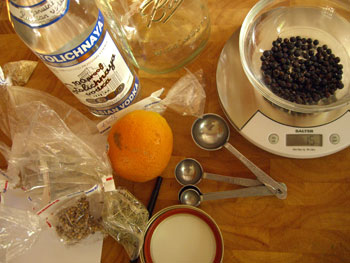
There aren’t many spirits that inspire such passionate opinions as gin does. I know vodka drinkers who recoil in horror when confronted with a bottle of Tanqueray, and gin drinkers who would rather abstain completely than suffer through a Grey Goose martini.
But what many people don’t realize is that gin and vodka begin life in the exact same way. You could even say that gin is nothing more than infused vodka. In fact, I’ve used this exact line on so many customers trying gin for the first time that I’ve decided to prove it to myself! What a better way to waste a bunch of time and ingredients while getting an opportunity to learn more about my favorite mixable spirit, right?
In his book The Complete Guide to Spirits (HarperCollins, 2004), Anthony Dias Blue describes cold compounding as a legitimate method for producing gin. He even provides a rough recipe for infusing a monster 2,000 liter batch. Not having access to a tanker truck of vodka or a hundred pounds of juniper, I did a little math and came up with something more workable.
That first batch was a drinkable, yet super-perfumed gin that I felt could be improved with a little trial-and-error. I won’t bore you with the details of my many failures before honing in on the recipe you’re about to see, but I will say that I’ve now got a liquor cabinet full of funky gins that may or may not ever be consumed.
I’ve tried to limit the ingredients for this very basic gin for two reasons. First, I wanted to use only ingredients available in the bulk spice section of my local grocery store. Second, I wanted to provide you with a basic gin that would be easily expanded upon by you, my three readers.
I got fancy and bought a digital scale for this project, so use one for maximum accuracy if you own one, or just follow my crude conversions if you don’t.
1 750mL bottle 100-proof vodka
1 750mL bottle 80-proof vodka20 grams dried juniper berries (about ¼ cup)
8 grams whole coriander, crushed (about 2 tbsp.)
2 grams dried orange peel (about 1½ tsp.)
2 grams dried lemon peel (about 1 tsp.)
3 grams whole cinnamon (about 1 stick)
1 whole cardamom pod, crushed
Use a mortar and pestle – or a food processor pulsed in five one-second increments – to break up the coriander and cardamom before adding them to the other dry ingredients.
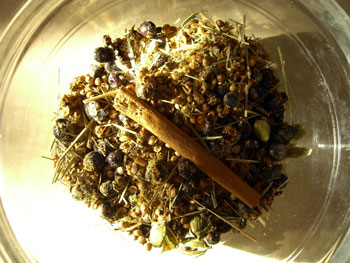
Once you’re certain that everything has been measured correctly, place the herbs into a large resealable jar and add the whole bottle of 100-proof vodka. I’m using Stoli 100 here, but there are a few options out there; just take a tour of your local liquor store and see what else you can come up with. Hang on to that bottle of 80-proof vodka, we won’t be using it until the very end.
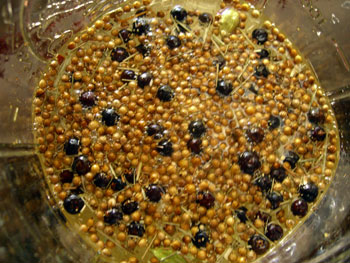
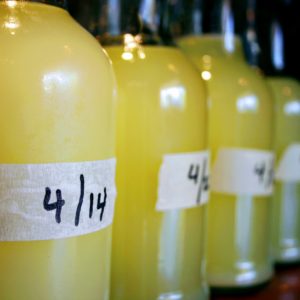
Place the jar in a dark, room-temperature spot for one week, and be sure to give the jar a good shake at least once a day. When the mixture is mature, it will look something like this:
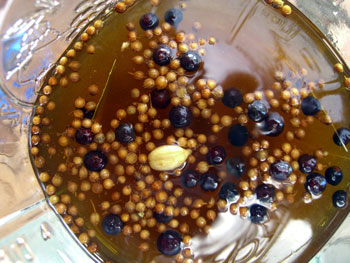
Yes, it’s got some color to it, and that’s okay. In fact, this is exactly what many commercial gins look like before they’re distilled a final time. You don’t have a still at home, so you’re going to have to put up with a little tint to your gin. You’ll be fine.
Taste it. It burns a little, right? Don’t forget that you’re running at 100 proof here. This is when we want to add that bottle of 80-proof vodka you’ve (hopefully) been saving. Taste it again. Better? Yeah.
Next we’re going to take all that macerated fruit and herbs out of there, so we’re going to have to strain the mixture through cheesecloth.
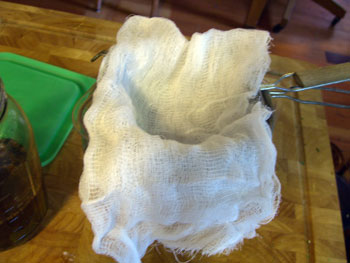
Wrest all the liquid you can from the wet ingredients, there’s going to be some vodka that just won’t want to let go. When you’re done you should be left with a mixture that’s free from solids but, (as we say here in the Pacific Northwest) still party cloudy. Enter the Brita pitcher. Get yourself a $20 Brita, or if you already have one, just a brand new filter. We’re about to put your filter through the wringer.
Note: be sure to follow the directions the fine folks at Brita have provided you. Soak the new filter for fifteen minutes, and then run several pitchers of water through it to activate that charcoal.
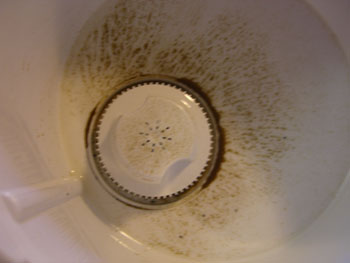
You’re going to see a lot of sediment in that filter bowl, and that’s a good thing. Keep running your gin through the Brita, say, five times, and don’t forget to rinse out the bowl between every pass. Soon you will have a crystal-clear spirit ready for mixing.
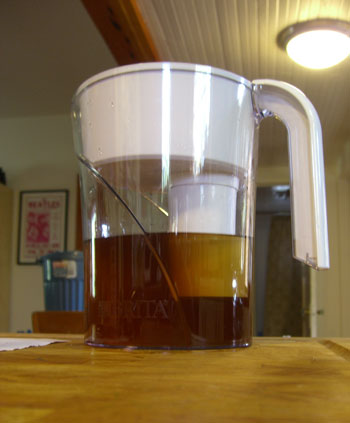
When you’re done, bottle your gin and start experimenting. Why not add some dried grapefruit peel to pair with a Negroni? Adding a single Kaffir lime leaf could be a nice way to add some more depth to a Pegu. Throw in a couple more cinnamon sticks this winter and try an Alexander Cocktail. I wonder how lavender would fare in Paul Harrington’s fabulous Jasmine. A double-dose of dried lemon peel in your gin for a souped-up Aviation Cocktail, anyone?
Here are some more suggestions for ingredients to add – in small quantities (think 1-2 grams per addition) – to flavor your next batch:
Thai basil
Cherry bark
Whole nutmeg
Cilantro leaf
Arbol chile
Star anise
Whole cloves
Indian sarsaparilla bark
Have fun, and if you get a chance to try the recipe, leave a comment below and let us know how it turns out!

The Tanqueray vs. Grey Goose standoff you described is spot on—I’ve seen that exact look of betrayal on a vodka drinker’s face when gin gets suggested. And I’m honestly a little jealous you got to test the “gin is just infused vodka” line practically instead of just repeating it to customers like I’ve done a hundred times. Curious if Anthony Di’s book gave you a specific botanical ratio to start with or if you just winged it.
We had fun making the DIY gin. I purchased the juniper berries and spices from Penzeys. I had to make a special request for 100 proof vodka at the liquor store. (I live in a small town on top of a mountain, 10,200′). I followed the recipe exactly, including using the Brita. I filtered it today and made Martinis for the family this evening!
Made this one last year:
2 Tbsp juniper
3/4 tsp coriander
1/4 tsp allspice
3 green cardamom
1 bay leaf
1 sprig rosemary (fresh)
2g grapefruit peel (dried – it was all I had on hand, so I weighed it)
1 tsp lemon peel (dried)
1 tsp lavender
Instructions as above, but my corner store was fresh out of Everclear, so opted to steep directly in 750mL Kirkland’s French vodka, tacking on an additional few days for the lower ABV (and thus, lower overall extraction potency). Filtered a few times on finish, and lovely! I like it better than my usual Hendrick’s. Can’t wait to try it with the Everclear for extraction.
The Brita filter does not remove the color but it does remove some of the taste. A cloth filter is the best way to filter sediment. Only do it a few times. Cost much less as well.
Hi Spencer, try not cracking the juniper. Also, limit how much of the other botanicals you use. Remember, juniper is the main ingredient and thus should also be the predominant flavor.
I am not sure about the brita filter for removing the color. I have used a new filter 8 times and still the color remains..
Not sure if anyone will see or reply to this, but I’m trying to do the infusion method with a variety of different recipes. However, it just turns out way too bitter each time. I’m using all dry ingredients. The worst was one with juniper berries, coriander seeds, and lemongrass. I’ve had luck making non-gin-like infusions (lavender vodka, ginger lemon vodka, etc), and those don’t turn out bitter. I also “crack” my juniper berries. Is there something I should be doing to reduce the chances of getting too bitter? I test it at one day, three days, and one week and they are all too bitter.
I just made this recipe but used 120 proof Everclear, as that was available at the time, with 80 proof vodka. Can someone please help me figure out the final alcohol content?
Just do simple maths. 120 + 80/2=100 proof. Divide by 2 again and you have 50 which is 50% ABV,ie Alcohol By Volume
I made this recipe and everyone loved it! It is very easy to drink! I did not filter it-i just strained out the spices. This recipe is a keeper.
There a multiple members of the Juniper genus. Some of them provide great flavor. However, some of them are toxic and could cause permanent damage.
I would be cautious with “found” juniper berries.
I’m so glad I found this site. I really enjoy gin now and then (Bombay Sapphire is my fave) but since I developed a citrus allergy I’m more than a bit gun-shy about the commercially available gins. Sapphire gives me hives now, and I refuse to drink a gin if it hasn’t got a published list of botanicals or if the list includes lemon peel.
Up until now, my “recipe” has been to toss a tablespoon of juniper berries into a 750 of middle-shelf Vodka and leave it alone until the berries sink (a couple of weeks). The result is much more gin than vodka, and it’s still clear and clean. And if you end up with a juniper berry in the martini, just fish it out with a fork, no big deal. But it lacks a lot of the depth and complexity of commercial gins.
Anyway, now I’m inspired. I’m going to try more variety of herbs in my gin. My current batch contains juniper, coriander, anise, clove, and bay leaf. It’s only been a day and it’s already gotten very brown from the tannins.
Another idea I’m considering–the way “real” gin is made, the botanicals are never immersed in liquid. They go in a basket hanging inside the still during final distillation, and only ever interact with alcohol vapor. Which may be why the tannins don’t end up in the drink. My next experiment will be to put 750ml of vodka in a clear gallon jug with the botanicals in a tea bag hanging at the top of the jug. I’ll seal it up and set the jug in the sun–and it will make alcohol vapor in the jug which will later condense back into the liquid. I figure, worst case the jar blows open and I’m out $10 worth of vodka and a handful of herbs.
I want to try this with hibiscus and elderberry… it sounds much like making a tincture really.
thanks x
Wondering if anyone has tried this compound method recently. I tried Jeffery’s recipe and let it sit for a week, but cannot seem to “distill” the color out of it, which remains as dark as rum or whiskey. Not much of a bother as it tastes great!
Wonder if perhaps Brita has changed their filters since this article was written.
It’s clear after filtering as in no sediment. But definitely still dark colored.
Is it Gin strickly from vodka–Or can you use rum instead of vodga with the species to create rum–gin.
I’ve just made my 5th batch of gin. I’ve modified the recipe a bit to make it easier. I just use Member’s Mark (Sam’s Club) 80 proof vodka rather than 100 and 80. I double the lemon and orange peel. I had a group of gin drinkers over for a blind (literally blindfolded so the color wouldn’t give it away) taste test. Don’t want to name names, but my line was rated as smoother and better than two expensive “artisanal” gins from California, and an imported London Dry. I tried a Brita filter but ended up using a coffee filter. Gets out all the solids and you only have to filter it once.
Thanks for the recipe ideas. I have a couple of suggestions that may cut down on your “many failures”
Instead of carefully measuring all the ingredients … and hoping that they are consistent from batch to batch, what I do is make separate infusions of each ingredient. So, I’ll make a fairly large infusion of juniper berries and smaller volumes of orange peel extract, lemon peel extract, etc. Then, without worrying too much about what strength each reaches, you can blend them (measuring carefully) in small amounts until you get precisely the taste you want … then scale everything up to complete your batch.
My other suggestion is to use Everclear instead of vodka. It’s cheaper (for the same amount of alcohol) and, since most of the flavors are more soluble in alcohol than water, you get quicker, more reliable extracts. If your start with 190 proof everclear, you just need to cut the end result 1:1 with water to get 95 proof (most good gin is 94) or a bit more if you prefer. Of course, you have to cut your blends as you’re experimenting with ratios.
Tried it. Mine’s not as good as some of the commercially available American gins that have come on the market since 2007, but it was fun to do. Like some others, I used 100 proof good old basic made in USA vodka and distilled water (for rinsing everything including the Brita filter). I’d do it again.
http://www.homebrewing.org/product.asp?itemid=1541&utm_source=google&utm_medium=ProductAds&gclid=CNyNzJ2z-8ACFZJr7Aod_CkANA
Pass the vodka through a carbon filter 2-3 times BEFORE you do the infusions, that will clean up a lot of the vodka taste. Use a high strength vodka , a you soak the filter in water before using, and use distilled water for that purpose. ,
keep up the good work!!
So I looked up if this was possible to do, this was the first thing that popped up so I thought, hell,why not. Five days in I see you on Best Bars In America, and I got super excited, kind of felt validation for trying this while my friends laughed. Tried your original recipe, then one with a ton of basil. They both turned out amazing. I feel like there is still a lot of vodka tinge to it though, was it something I did, brand, not enough infusion…any ideas or am I crazy. I can’t wait to get started on my next batches.
Thank you, Jeff, for this FUN idea!
I’m a whiskey gal myself, but my brother is a HUGE gin fan sooooo – you’ve given me the perfect idea for a Christmas present for him. I’m going to play a bit and see if I can’t come up with 6 mason jars of different flavored gins.
Any other cool funky ideas for flavors out there? He’s a ginger-lover, too, makes a mean ginger brandy…
THANK you!
What’s up Jeffrey! Your blog rocks. What would happen if I did this process with tequila instead of vodka? We have a metric shit ton of tequila in our bar that we are not using because of a menu change and I want to experiment with it. It sounds disgusting, but who knows?
A cupboard full of funky gins that you may or may never consume? Sell them to college students super-cheap. They will drink anything that gets them drunk. Now, I strongly discourage you from selling alcohol to the underage, and I feel obligated to say that it’s quite wrong & a bad idea to boot, but they might even pay full price for shitty, shitty gin.
look at volumes, if you have say 100 ounces at 100 proof and have added 100 ounces at 0 Proof you now have 200 ounces at 50 proof
see wiki
Alcohol proof
From Wikipedia, the free encyclopedia
(Redirected from Alcoholic proof)
Alcohol proof is a measure of how much alcohol (ethanol) is contained in an alcoholic beverage. The term was originally used in the United Kingdom and was defined as 7/4 times the alcohol by volume (ABV). The UK now uses the ABV standard instead of alcohol proof. In the United States, alcoholic proof is defined as twice the percentage of ABV.
The measurement of alcohol content and the statement of this content on the bottle labels of alcoholic beverages is regulated by law in many countries. The purpose of the regulation is to provide pertinent information to the consumer.
Contents
1 History
2 Governmental regulation
2.1 European Union
2.2 United Kingdom
2.3 United States
2.4 Canada
3 See also
4 References
5 External links
History
This section needs additional citations for verification. Please help improve this article by adding citations to reliable sources. Unsourced material may be challenged and removed. (April 2013)
From the 18th century until 1 January 1980, the UK measured alcohol content in terms of “proof spirit”, which was defined as spirit with a gravity of 12/13 that of water, or 923 kg/m3, and equivalent to 57.15% ABV.[1] The term originated in the 18th century, when payments to British sailors included rations of rum. To ensure that the rum had not been watered down, it was “proved” by dousing gunpowder with it and then testing to see if the gunpowder would ignite. If it did not, then the rum contained too much water and was considered to be “under proof”. Gunpowder would not burn in rum that contained less than approximately 57.15% ABV. Therefore, rum that contained this percentage of alcohol was defined to have “100° (one hundred degrees) proof”.
The value 57.15% is very close to the fraction 4/7 = 0.5714. Thus, the definition amounts to declaring that 100° proof spirit has an ABV of 4/7. From this, it follows that to convert the ABV (expressed as a percentage, as is standard, rather than as a fraction) to degrees proof, it is only necessary to multiply by 7/4 = 1.75. Thus pure, 100% alcohol will have 100×(7/4) = 175° proof, and a spirit containing 50% ABV will have 50×(7/4) = 87.5° proof.
The use of “proof” as a measure of alcohol content is now mostly historical. Today, liquor is sold in most locations with labels that state its alcohol content as its percentage of alcohol by volume (ABV).
Use of the term “percent proof” has no meaning: Proof should be stated as “degrees proof” (UK), or “proof” (US)
Many countries also use a measure called a standard drink. In Australia, a standard drink contains 10 g (12.67 ml) of alcohol, the amount that an average adult male can metabolise in one hour.[2] The purpose of the standard drink measure is to help drinkers monitor and control their alcohol intake.
That should say non alcoholic !
What a wonderful forum/ discussion. I have a couple of questions – if I use the 100 and 80 proof bottles then the final output is 90 proof?
If I then choose to add another liquid (moon alcoholic perhaps) how do I determine the final proof output?
To CharlieE
thanks so much for suggesting the dried fruits. I simply never thought of the obvious choice. I have had pear brandy from a distiller upstate NY, that was expensive but woof an incredible pear brandy. Made from perry distilled then racked on pears for a year (I think), incredible. You taste pears for a good 5 minutes. Perhaps I will try the dry cycle for fruit liquer!
thanks
chris
I do not have bottle handy but if requested I can find my empty 🙁
wait wait here it is
http://www.harvestspirits.com/
Next time I am near Albany I will restock! 🙂
To CharlieE
really nice Juniper berries can be gotten along with TRUE Cinnamon , or Ceylon Cinnamon at http://www.penzeys.com/ . My kid tried to get me to go there, I didn’t. I finally did, while it will never replace Aphrodesia in Manhatten, (weird people and obnoxious cats aside, or is that weird cats and obnoxious people aside), it is still around and has stores in many states!
Cassia is what most people take for cinnamon. If you want health benefits you MUST USE TRUE cinnamon or risk injury.
google true/ceylon cinnamon to see the diff.
As for taste, you simple must try some to grok it.
It will make a difference in anything you use cinnamon in. You may prefer cassia, but it is different!
To Joe Hutchins
Worm wood has no drugs in it that get you more high then the alky spirit. It just gives it a flavor, (for better or worse as you taste it).
I’ve been infusing vodka for years with various things, including fruit. I’ve found that dried fruit always provides a more intense flavor than fresh, plus fresh fruit tends to add juice to the mix. You want the flavor, but not the juice.
Simple solution to that – take your fresh juniper berries and put them into a food dehydrator until they’re dry.
Dehydrators are fairly cheap, and you can buy them at Wal-Mart.
Going shopping tomorrow can’t wait to try.
Try infusing oolong tea with it.
I have infused some of my sugar & apple juice ‘shine with juniper from trees on my dads place in OK. shine was 3X distilled prior to infusion with juniper & lemon zest. I used about 1 cup/gallon, let sit about one week. One last distilation after infusion left a green tar in my still and a very heavily perfumed liquor. I cut it down to 120 proof, but it was still too heavily perfumed, but has mellowed some after sitting about 6 weeks.
Next I plan to try a reduced ratio with some rocky mountain berries.
I wonder if there’s a difference between using a Brita filter and the zero water filtration system since it takes out all cloudiness and color from the water it’s purifying. Seems valid, butif it reduces the alcohol content or flavor, seems like it’s worth the investment to figure out. Might even replace the distillery if it doesn’t reduce any aspect of this wonderful spirit.
Years ago I had a neighbor who soaked wormwood sticks in vodka for several months. This was supposed to be a really mind affecting beverage. Anyone heard of this?
You can buy an air cooled table top still from Mile High Distilling. Just Google them.
I don’t believe anyone has reported this, but I found using Smirnoff (100 & 80) to be a poor choice, if, like me, you were hoping to make a dry style gin. I am not a vodka drinker, so little did I know that Smirnoff is sweetened and probably has glycerine as well as other additives to make for smoother drinking. Anyway, the Smirnoff-turned-gin was much too sweet for most classic gin drinks, but was very sippable on its own! I haven’t tried Seagrams (in the same price range as Smirnoff), but I would recommend sticking to Stoli 100 to be on the safe side. Cheers!
I made this last Christmas as a gift for my brother who loves gin. I did mess up, got ahead of myself, and added both bottles of vodka at the beginning. It must have worked out just fine, because he is still talking about it. I am about to make this year’s batch and see what following the directions does for it!
Last New Year’s Eve, I brought this gin and homemade brandied cherries to make French 75s. They were a huge hit, and are on my list for all holiday BYOB parties.
Thanks for such a fun idea!
Hi Natalie,
tried it it was a dud true waste of time and money I will just buy cherry herring.
I tried the new grand marnier cherry product . Not worth the price of admission, not at all.
I found an incredible pear apple distiller near albany ny. expensive yes, incredible pear liquer, oh my oh dear….I only let a few people have a taste cuz it is as expensive as good single malt. Your mouth tastes like pears after it goes down woof!
He make “perrie” then stills it then parks it on pears for a year. Finest fruit brandy I have ever had, nt that I have had that many, but this is kick butt!
if there is ntrest I will post the name/address.
If you are anywhere near albany it is worth the extra mile. And the apple pies are great as well.
A few weekends ago was motorcycling along WI-35 by Lake Pepin. At one wayside rest, there were several junipers, loaded with berries. I filled one pocket, having already read this article. Followed this recipe exactly, except for fresh vs dried juniper berries.
Finished the filtering yesterday. Ran it through the Britain about 10 times. It is not the slightest bit cloudy, but I sure would call it a lot more than “tinted”. Darker than Cuervo Gold. About the same color as Jameson, Bushmills, Balvenie or Two Gingers.
It tastes lovely. Used Smirnoff for the 100 (only 100 I could find), and Six for the 80.
When I read “crystal clear” and “a little tint”, I was expecting something not nearly this dark. So even though I will drink it, I am disappointed with the results (my girlfriend will NOT allow this in a martini).
Christie,
Try mixing one part of your cherry liqueur with two parts Simply Lemonade or Simply Limeade and serve over ice. Amazing!!!!
My cherry liquer was a dud. All whodrank some said it was like cough syrup 🙁 .
the cherries seemed toretain more alcohol then the liquid. I used it to make sangria’s and on a happy note of you added say two shots to a glass of ice and poured in seltzer you had a nice cherry soda. Perhaps I will try blue berries next!
ciao
Nifty idea, thanks for the recipe. I’ve done alcohol infusions before, trying to approximate absinthe and just making various herbal liqueurs that don’t warrant any mention in public, and I found that if you put the dry ingredients into a little cheesecloth satchel and pour the vodka over that, you’ll save yourself that hassle of straining out a bunch of plant material, and the pain of accidentally ingesting a piece of whole cardamon in your cocktail (true story).
did anyone notice how he says to use a mortar and pestle to break up the coriander and cardamom before adding them to the other dry ingredients, but then in the picture you can see the coriander floating on top of the alcohol when left to soak?
dont think it really matter and I’ll soon find out with trial and error.. but would be nice to clear up on that
cheers for receipe thou!
I went to that site very nice, I posted back if they do not make berries what have I got in my spice cabinet? they are bluish black sticky and nasty when consumed alone, but tasty in some foods.
I have a junipoer in my back yard (i think).
ciao
christie
Christie- it’s in Portland, Oregon.
I am curious if anyone has bought unripe juniper berries commercially, or has foraged them around Northern California. My first couple batches have come out wimpier on the juniper flavor than I’d like. I’m trying first crushing the dried ripe berries and maybe eventually simmering them in a little water to extract more flavor before mixing with the vodka, but if those don’t work I guess I need to hunt for the unripe version to get extra pinene and other woodsy compounds in the finished batch.
BTW- I’ve found the gin pages at homedistiller.org very useful as a jumping-off point for experimentation. There’s a section there on what ratios are good ideas for your flavoring components so you don’t go overboard on, say,the citrus. Also http://www.liquorpress.com/2011/02/16/juniper-examined-the-gin-secret/ is nice if you know a little chemistry (all these compounds appear to have higher boiling points than water, so you won’t boil them off if you simmer the berries a bit). Though I can’t vouch for any fun chemical reactions that might result from heating, changing them into other stuff!
Hi Jeff!
I do appologise but I thought perhaps that this site was not manned at all anymore. I inherited a site from a gent who died, he did it about 3 -6 months before he died. He told me it would not allow newbies , but it would go on forever.
When I see long patched of queries w/o answers I oft think of him.
I am glad to see you just are whipped for time, this was a great article and is among the ones that inspired me to make a batch of cherry. This first “adult drink” I ever had that I liked was Cherry Herring. It was glorious. I could just buy it now I can actually afford it, but making ones own is more interesting. I cook from scratch and used to make my own beer. I confess I am a slacker I used syrups not dried grains. It was at least as good as Deutch Brau, but it is time always time that screws things up.
So the cherry Liq is easy (so far) and even this gin looks easy.
A good knock off or Grand Marnier is what I would love to get. It is my second favorite liquer.
If you have any info on Juniper berries it would be fabulous, if you figure out how to make GM it would be great, (not contreau). Where is your bar?
ciao
christie
Hey Danny,
I do not believe that Jeff M reads this anymore as he nor anyone else has responded to posts (sad).
I would love to know if my juniper out in my yard is usable for such purposes.
Since no one else seems to care enough to respond I suggest you use at least the same amount of fresh then taste and if it is too strong weaken it with more vodka.
I put up a batch of cherry liquer b4 Xmas I uses 160 proof vodka ( NY state allows a max of 160 proof other states allow 180 🙁 )
Next batch will also be at 16o then after that 180 (everclear). The reason being I want finished product at 80 proof and to do that with sugar and more water the higher the spirit level the easier it is when diluting the final product. Should be done after april 30th.
MMM MMM MM good MMM MMM Good morning VOdka is Mmmm MMM GOOD!
ok ok that was uncalled for, but is anyone reading this?
TTFN
Chris
Although I’d love to have time to respond to everyone’s question or comments, the sad truth is that I just don’t. In between running a bar, schlepping drinks five nights a week, and trying to maintain an actual life, my schedule is pretty full.
So all I can suggest is this: try my recipe and my detailed instructions above. If you want to try something different, please be my guest – the odds are good that I haven’t tried every possible permutation of this recipe, up to and not limited to fresh juniper berries from your tree wherever you happen to live.
But if you do go out on your own and try something new with this recipe, I encourage you to post your results here so that others can share in your success.
Cheers.
A couple people have asked, but nobody has answered regarding picking fresh berries. i was just out in the California desert and I picked some fresh juniper berries off a tree that’s over 1,500 years old, I’m told. It seemed like a good idea to make some Gn from that.
Anyone know how to adjust the recipe for fresh juniper berries? Are there different kinds of juniper? It sure smells like gin straight off the plant.
Brita filters and juniper berries
1) I read the treatise on how to charcoal filter spirits and kangaroo filters are reasonable, but not the best way. I noticed they make them wider now and that helps. And one must pour th ebooze through 4 times to make unflavored booze drinkable. Once you infuse the booze, passing it through more then once could quite literally clean away the flavors you just added. So a material filtering followed by a carbon filter (1 time) I would think would be helpful. Then again the Brita and the Kangaroo are both really small. Ideally you want a pipe that is 3 feel tall and 1 1/2 inches in diameter. If you make your own colum you need to boil the charcoal and rinse 5-10 times and keep it wet up to the second you pour in the spirit.Then you pass the spirit through and never let air get in it. In theory you should get a much better quality then a brita or gray kangaroo. Charcoal type is very very important, fish tank stuff is not good.
Also you can reuse the stuff if you boil it and dry it in an oven (dicey proposition if you don’t boil wash it a few times first, you risk a fireball and severe harm)
Grey Kangaroo will give you cheap refills if you send in old ones. I suspect they pop’m open wash’m and recycle the coal, Bravo to them, that makes good sense.
The process they use to make AC is nasty and that is why you need to wash out, boil, wash out a new batch of AC before using it. Wetting it before use is to AC what warming up is to you, it prepares the receptor sites to get working. If you don’t (assuming no dust) you must do a few extra times.
Juniper berries,
can any one tell me if the trees that grow all over LI (eastern cedar?) are what one needs for gin and pot roast?
I did not realise that the berrries take a year to grow. And the nicve ripe ones are behind the weird looking front ones. I am going outside now to check out my tree.
thanks
f anyone is reading and responds
chris
Hi Dave,
I must ask what is a marrow? sounds interesting.
Also
can anyone answer a repeated question, are the Juniper Berries we find on Trees used around houses the same junipers that we need to make gin, or really nice pot roast?
I have a bigun in my yard and they grow all over Long Island so any help here is appreciated.
HI my friends carribean grandfather useto make slow gin,using a large marrow,cut the top thinly,scoop out the seeds only,then fill the cavity with brown sugar,place top back on,make three hole in the base,with chop stick,or similer Item for drainage,and wait,but keep topping up with brown sugar,until only the skin is left,is this true,has anybody come across this or similer,it would be great to fined out,and if its true,what about large mellons.
Hi, Jeffrey! I tried it and posted the results and links back to you on my snarky urban homesteading blog (fermentation, food, gardening, fishnet stockings…). We tweaked the process a teeny bit, made only half as much, and changed up the spice mixture (and added lavender!) We also got my stuffed animals totally trashed, which I do regret because we’ve been trying to get them into rehab for some time.
http://thealchemistblog.wordpress.com/2011/07/13/how-to-turn-cheap-vodka-into-classy-gin-using-a-water-filter-or-i-promise-not-to-get-you-arrested-this-time/
Enjoy, and thanks so much–we love it!
Genevieve
this is just so very cool, I need to comeback and see how to fake a nice Granmarnier if possible. I read years ago the ingredients list is as long as my leg , but I thought I could do something like was done here.. And one day I will make this I want more info on how to reuse the brita cause I think it goes bad if not used once opened and wetted..
chris
I just took the recipe and used it as a base for 4 different gins. One as is, one with double citrus for aviations/last words, and two with rendered bacon fat and clove, one with a little apple as well. I really can’t wait!!!
You guys are wild ! Can’t wait to try all the ideas and so on. Lived in England a while back for a year and had a good time with Tanqueray but this sounds like a great adventure.
Thanks for the info
Shouldnt u guys add water to decrease the ABV of the final solution ??
Re to lsal
Do you think the BATF has nothing more to do than worry about someone making a gallon of booze in a still? Start makinf 10-20-50 then you’ve got them knocking down your door. Or maybe you’re the tax man for Obama and want to help pay for his stimulas plan.
Dale,
I am also a longtime Bombay (Sapphire) drinker and let me tell you if you use the recipe on this blog you will get a bottle of what I thought tasted like potpourri. Way too strong. Here is what I do to test. Work with only a cup of 100 proof at a time and tweak the flavors until you get something you like. I have a recipe I’m working on now that tasted pretty much like Sapphire and smelled nearly identical before it went into the Britta. The filtering definitely takes some of the flavor and aroma away but I don’t think you’s want to drink all that herbal residue? So maybe start with something a bit stronger than your desired result. I’m still experimenting too but here is my test recipe:
1C 100 Proof Vodka
1C 80 proof Vodka
3Tbs Juniper Berries
2/3 tbs Coriander
5 cardomon seeds (about 1/3 of a pod)
2 pcs of orris root about 1/8″ long
1 pc of Angelica Root about 3/8″ long
1 pc of cinnamon about 1/8 x 1/8x 1/16 (a sliver)
3 small peppercorns about the size of BB’s ( I used a green, white and a black)
1 pc of dried lemon peel about 3/8″ x 1/4″
1/3 of an almond
Put everything except the juniper in a magic bullet and grind it with the flat blade.
Put the cup of 100 Proof in clean and dry mason jar and add all the ingredients.
Let it sit for a week but shake it vigorously several times a day.
After 7 days, strain the herbs out of the vodka with Cheesecloth. Do not squeeze to get the last bits of alcohol out of the cloth because it will just add a bunch of junk you don’t want back into your booze.
Once the big stuff is strained off run it through the Britta 3X. (Make sure the filter has been soaked and prepped according to directions or you will get a bunch of carbon dust in your booze)
Now add the cup of 80 proof vodka to you 3X filtered 100 proof gin and filter the mixture 2 more times.
You’ll end up with some pretty good stuff. It won’t taste the same as Bombay but it’s very drinkable. If you want to make it stronger just increase the recipe in baby steps and record everything. You will eventually find something you like. I find that cinnamon, orange and cardamom are the real strong flavors. If you put a whole stick of Cinnamon in anything, that’s all you will taste. I used a strip of orange peel about 1/4 inch wide and 2″ long in the above mixture and the gin had a stronger citrus than juniper flavor. Almost too much orange that’s why I reduced it to what’s in the recipe. Not to say it wasn’t drinkable, because it was, it was just not Bombay(ish) enough.
Also remember your gin will look like Iced Tea at best using this process, if you re even able to make it that clear.
Good luck and good tasting!
Hi Jeffrey;
I’ve been a long time Bombay drinker, and my wife has been laid off from her job now, so on one income, we’re looking to save money. So… if I use your cold infusion simple method without the still, and buy cheap vodka, will it taste like Bombay, and will I save a lot of money?
Could I use fresh berries off a Juniper bush? Should I dry them and how do I know when they are ready to pick? Lots of questions, I guess.Thanks.Carol
Great site, thanks for the info.
In England we add sloe berries (prunus spinosa) from a blackthorn bush to the gin. They are commonly found along the sides of railway lines. Turn the bottle once a month for about 6 months and the taste is amazing.
Make it in summer ready for Christmas.
Thanks.
i have a family history of bootleggers in the US and have been making bath-tub gin as we call it for a long time.
one tip.
once you have the botanicals prepared, but them in a mason jar and pour enough vodka in to cover them by 1/4 inch or so. place the jar in full sun. just like you were gonna make sun tea. but no lid. once the liquid is hot to the touch, put it in the shade until cool.
pour the gin tea in to jar/jug; botanicals and all. follow the recipe.
If you add a small dog turd – say from a Dachshund or a Schnauzer, your gin will taste like crap.
A fun article.
Yes, G.N. is correct. “Redistilling” uses a still and requires the payment of taxes and therefore falls under the TTB’s purview. If you are running a still (to distill or “redistill”) you do need permits – federal, state, local (among others). Many distilleries begin with neutral grain spirits (NGS) and “redistill” them to add flavors or complexity. They pay taxes to the TTB just as those who distill from scratch.
If you want specifics go to http://www.ttb.gov and your local state alcohol regulatory body.
If you don’t think the TTB will come looking for you even if you just distill a small amount, just google the words “moonshiner arrested” and you’ll get many hits like these:
http://www.washingtonpost.com/wp-dyn/content/article/2005/10/06/AR2005100601833.html
http://query.nytimes.com/gst/abstract.html?res=9B03EFDA1530E633A25754C0A9669D94669FD7CF
Sorry to be the party pooper but I just want everyone to have fun with the infusion and stay out of jail!
I feel compelled to leave a response here, as I just had the idea to “make my own gin” to give to my Mom for xmas, and this was the one source I found online that reassured me it could be done! Thanks. One thing I’d like to point out, at least with my own experience, is that after adding the various ‘botanicals,’ my 750 mL bottle of North Shore vodka (from Lake Bluff, IL) already tasted like the best gin I’ve ever had! I’m not sure how it extracted so much flavor so fast. I ‘rotated’ the bottle a dozen or so times to shake stuff up. I also toasted half of the ingredients before adding, and lightly crushed others a bit. But it is definitely already GIN, and the flavor is pretty intense already. I’m now curious as to why you let the ingredients steep for a week? Here’s my experiment for what it’s worth (approximation):
-1 750mL bottle vodka
-10 cracked juniper berries
-1 Tbsp. coriander seed
-3 whole cloves
-3 whole green cardamon
-1 star anise
-3 allspice berries
-1 cinnamon stick
-1 whole nutmeg
-1 small piece ginger root
-5 mint leaves
-2 large fresh orange peels
-2 large fresh lemon peels
looking at the pics of the herbs above… and comparing vs. the ingredient list.. there’s something in there that looks rosemary-ish.. but don’t see that on the list.. just curious what is it? doesnt look like one of the extras either but havent used them all before.. thanks for the great idea though…
So I have tons of Junipers on my property. Could I use those berries? Non dried? How much would I need, or do I need to dry them first? And If I need to dry them what do I do? Love the idea of Gin from My own garden!!!!
Just to answer the point on the infused vodka going cloudy when diluted with lower proof vodka, it was the high 180 proof vodka that extracted more of the essential oils from the botanicals which when diluted back caused the infusion to cloud. Alcohol is very good at extracting essential oils, but in this case there was more than could be contained in the lower proof liquid- Pernod is a good example of this- as soon as you lower the proof it clouds as the essential oils from the aniseed fall out of solution.
I had a similar experience when diluting an infusion of other botanicals in brandy with some white wine according to a centuries old recipe to make Royal Usquebaugh – I thought I would be clever and use more of the wine than was specified (as the spices were stronger than I wanted after infusing) and the result was a cloudy (but delicious) drink when mixed back with the wine.
Pick ripe and unripe Juniper berries. Juniper berries take more than one year to ripen and the blue/black ones are in the back. More unripe berries will give a greenish cast to a gin and tonic. The ripe ones give more of an amber color.
Get the highest quality, highest proof neutral spirit you can. Avoid the golden grains and other high test ethanols, they include a high proportion of the heads and tails you would avoid in multiple distillations.
Soak a bunch of the berries in the alcohol for several months. In a 32oz bottle one cup of berries is good. No matter what the concentration you can adjust this when you mix with the unflavored alcohol.
Use this mixture to flavor your alcohol. One bottle of highly concentrated juniper extract can flavor an awesome summers worth of bottles of gin. Fresh juniper berries come out better than the dried juniper you can get on the Internet.
All those other subtle flavors of fruit and spices can always be added but first get to know the fresh combination of highly distilled spirits and juniper as the starting point.
To Leif, an alcohol free gin is blasphemy. Its flavored booze, if you remove the booze, its just flavored water. You can’t freeze gin at normal temperatures, I used to keep a bottle or two in the freezer for emergency cold drinks.
That is why antifreeze was alcohol based in the beginning.
You could either boil off the alcohol – dangerous and should only be done outdoors with lots of ventilation – or dilute the gin with enough water to freeze it and then separate the alcohol by freezing.
Feel free to experiment, but I think you are moving in the wrong direction. You should try adding alcohol to items that don’t normally contain it, like chocolate milk or pudding. That’s the edge of science where the real research is done.
Thanks Jeff for a stimulating and fun site. The posts are great too. Question. Is it possible to create an alcohol free gin? Someone told me that Budweiser uses real brewed beer for their O’doull’s brand of N/A beer, and simply freezes the beer, then pours off the alcohol which doesn’t freeze. Doable with gin?
Jeff, thanks for the recipe. I tried it out this week. I sort of jumped the gun and couldn’t wait the entire week for the mixture to mature. Found most of the ingredients in my local Whole Foods. Sipping on my infused vodka and ice right now. I have to give it two thumbs up. Craig
WOW!!! Just talked with a friend last week about how to make gin. Went on-line today and found you on the first try!
I guess I’d better get going. Have juniper in my yard and God knows how many in the surrounding area. Also, can buy it bulk from an herb company with whom I do business.
Thank you, thank you.
Thanks for this awesome and inspiring post! It sure has legs …
My question: I am used to making Italian infused liqueurs such as limoncello, nocino and “44”.
The method for limoncello is to soak lemon peel and any additions in 180+ proof alcohol for a couple of months, then thin that down with a water/sugar syrup to your own preferred and drinkable proportions (30-40% alcohol) and sweetness. This final mix improves with some aging.
Would this be a valid way of adapting your method? Basically, I’d soak the juniper and botanicals for (I really wonder how long) some amount of time, then thin the stuff down with filtered water to 40-50% alcohol content. If you soaked your stuff in vodka for only a week, I guess infusing almost pure alcohol any longer than that would be unnecessary and might bring out undesirable flavors?
I’m planning on putting the first batch of this down in a week or so. Anyone with experience on this willing to give me advice, I thank you in advance!
Sounds brilliant and really easy. I like that you used normal household items rather than a fancy reflux system! I can’t wait to try this. Thanks for sharing.
I have a ton of juniper bushes (well a lot) in my back yard so today I stuffed a bottle of 100 percent alcohol with tender ends of juniper shoots, berries and all.
Think it will work if I infuse for a few weeks ? May make good go-juice for my car :>)
Jeffrey,
Thanks so much for posting this. After scouring the internet and reading a lot of “gin” recipes this one looks like a winner. I just ordered the spices and look forward to making this for a fourth of July party.
Your site is great, keep up the good work!
This method could revolutionize the medicinal marijuana industry, where the marijuana turbo charges your metabalism helping those suffering from loss of appetite due to terminal illnesses, the alcohol then acts as a blood thinner to reduce and prevent deadly blood clots often experienced by hepatitis patients. This is Nobel prize worthy research (haha I wish)
Well I have a whole new twist to the situation, I have been pouring over all the information I could gather to figure out how to accomplish what I am after.
I first thought I could use the process from http://www.infused-vodka.com to make the gin I’m after. I would use their simple soaking infusion method with a commercial gin instead of vodka, that way the gin flavour is already perfect and I’d just be adding my own desired flavours like fresh blueberries or blackberries and star anise or licorice root for example, great flavour combination.
But after reading this almost chai-tea like recipe to turn vodka into your own gin, I think I’ve decided that this process would be much more effective for me to add my secret ingredient to the spice mixture.
Now this secret ingredient is highly controversial I know… but being Canadian and being born and raised in beautiful British Columbia I don’t really care. It can be added the same as any other herb, just leave it on the stem, and add as little or as much as you’d like for desired potency. That’s right folks, thanks to this process I now have the perfect recipe for Marijuana Gin.
Not only will the flavours and aromas be masked for those who find them unpleasant, but the tea like “steeping” infusion process allows for all that wonderful active ingredient THC to be released. Adding a whole new kick to this “home grown” brew. Thank you all so much for your additions, I’ve been scouring the net for ages.
any reason to not use fresh juniper berries??
Just made a batch of this with two friends over the past week. We used very, very cheap vodka for both the 100 and 80, but kept to your recipe except that we used fresh grapefruit zest instead of lemon peel. It came out absolutely DELICIOUS. We’re already planning two new batches: one with fresh ginger and one with herbs de provence. Thanks for the recipe and great time!
I haven’t tried this yet, although I hope to soon. I was searching around for other ingredient lists to see what other spices can be used, and found this page telling the spices in Citadelle gin (which I’ve never had):
http://www.citadellegin.com/en/epices.php
… thought it might be interesting for ideas
Adam:
from homedistiller.org:
If your gin goes cloudy, it means that you have too much oil present for the % alcohol – either up the % alcohol until it dissolves again, use less oil, or just drink it cloudy.
I’m thinking the use of fresh peel upped the oil content
I’ve just started to experiment with spice infusions, after a long history of making sloe gin (1lb sloes, 1lb sugar, 1litre gin), I’ve infused gin rather than vodka, to make a more spicy G’n’T.
combos of cardamon, coriander seeds, fennel seeds and extra juniper berries.
With respect to distilling, essentially you are Re-distilling a spirit, not deriving a spirit from a fermented product, so I’d say no worries. Anyway, I’m sure the boys in blue have bigger problems than a home made G’n’T
Dear god man…..you have waaayyy too much time on your hands…..
people are concerned.
Hello
Sounds like a cool idea for the holidays, I will probably try it if I can find the Juniper.
One thing that I think is missing from all this discussion is the legality of distilling your own alcohol, from what I have read on the internet, distilling alcohol in the U.S. is still illegal without a bunch of permits. I am pretty sure buying anything from the brewhaus dot com site, sending it into the US and then making vodka is very illegal. Maybe I am misinformed but here is some stuff I found online:
Under 26 U.S.C. Section 5171 operations as a distiller, warehouseman or processor may be conducted only on the bonded premises of a qualified distilled spirits plant. To qualify such a plant, a registration, application for permit and bond must be filed in addition to other supporting organizational documents. 26 U.S.C. 5178 places restrictions on where a plant can be located.
I found this at homedistiller.org
They say that “moonshining” is only legal in New Zealand.
First of all allow me to say this is a fantastic post! It has me thinking about all the possibilities I can create. However, I am still new to this whole game and have some questions….
So I guess it has been agreed upon that some major commercial producers are using vodka as their base spirit, adding in whatever herbal recipe they desire, then are re-distilling via a pot still/gin head/whatever still (Bombay Sapphire uses the gin head technique). In regards to soak times of the herbs I initially read 24-48 hours of soak time in the base spirit is the way to go. Regardless of soak time, would re-distilling it remove the brown color and get you back to a clear product? Also…I don’t understand the difference in making an gin essence and actual gin? Would the method described on this page, combined with re-distilling, be considered an essence or gin? Sorry for the silly questions, but I am totally new to this. Thanks!
Tom – You’ll always get out what you put in, so beware cheap ingredients.
And whatever you do, DO NOT HEAT this, or any other high-proof alcoholic beverage. You run the risk of fire or explosion if you don’t know exactly what you’re doing.
do you think it matters what quality vodka you use. i just bought some nice 100 proof vodka but to save money (as the 100 proof was pretty expensive) i went for a really cheap 80 proof one (chekov to be precise). will this ruin the 100 proof one or is this an ok money saver.
with regards with making the gin. do i literally pour the second bottle of vodka in with the mix without heating anything.
thaks for all the help guys. much appreciated
tom
Found Jeffrey’s article and thread really interesting, and finally took the plunge and made my own batch of home-made gin. I decided to vary the recipe and method slightly, and the results were not exactly what I expected.
Instead of 100 proof vodka, I used 180 proof, which I thought would work just as efficiently to release the flavors of the botanicals, and which I could dilute later to reach the desired proof. I also substituted fresh orange and lemon peel for the dried variety. Just for variety, I also added 2 pieces of star anise to the mix.
I let it sit for the prescribed week, shaking occasionally. The mix smelled GREAT, and I thought I was onto a real winner. I strained out the botanicals, and then added the water to bring it to 90 proof. That’s when it happened…the mix turned as cloudy as a shot of Pernod to which you have added ice water! This didn’t bode well, but I pressed on and filtered the gin 5 times through unbleached coffee filters. The result was a yellowish, cloudy ‘gin’ with quite a bitter taste. I ascribed the bitterness to my sloppy peeling of the orange and lemon, which left too much pith on the peel. But did this also cause the cloudiness? I’m not discouraged and will try again with the 100 proof vodka this time. Any comments are appreciated!
May be Jeffrey is allowing me to answer…
No: to use vodka is not a cheating!
Commercial producer are actually distilling after their maceration another time. This not only makes the spirit clear and crisp – but also further refines the alcohol!
It is obvious, that better producer also using more refined neutral spirits [or refining themselves]!
And of course our friend Jeffrey wouldn’t ever cheat – would you Jeffrey?
actually im an idiot i just looked back and all the botanicals were added before the filtering. lol.
i think i will try this as i need to produce some home made gin for a degree project.
your using 100 proof vodka but is it possible to not use vodka like some other pure spirit? cause is using vodka kind of a cheat method of making gin rather than making it properly?
i got told about something called everclear, which is a pure spirit. but apparently its not very refined.
also, after you filter the liquid, why is it then you add the botanicals. why not before the filtering. and cause it is after it, do you leave them in the gin to add say a “rustic effect” or do you do another filter. thanks and sorry for all the questions
tom
Welcome to the site, NJLady. Thanks for writing in.
Here I thought I was the only one who filtered with a Brita. I’ve used it to tame some of those bottles of gin I found overly flavored for my taste.
With two elders who were both chemical engineers, I found it’s easy to restill with a stilling apparatus. However, usually with vodka, I set the stilling exercise to run so that what precipitates out of the cooling tube would be crystal clear neutral spirit — extremely slow flow rate. When stilling was done by them, it was generally run at a higher pace in order to purposely keep some of the flavorants in the cooled final product so that less water would be needed, and to preserve the distillate’s characteristics. It winded up tasting like tequila to a certain degree (due to the yeast from the alcohol making process).
What I’ve done is basically run an intensely flavored gin through a Brita about 10x for a smoothing effect that tempers the tastes. I’d never redistill gin to purify it unless I had a commercial alembic still because it would completely neutralize some of the good characteristics I would want to remain in the gin.
This thread warms my heart. Brings me back to the days of the copper pipe and silicon tubing line that my cousin architected to fit the need . . . it was just long enough to reach from a corner burner to the kitchen spigot.
Best wishes and thank you for allowing my comment. I’ve been an afficionado for a while now. Quite inspiring.
Oh, PS He may have tried it at full strength (not advised). Always bring it below 120 proof and use clean mineral free water. It really does improve the taste. Notice that rums tend to be 70-80 proof, gins 85-95 etc etc. Each has its optimum dilution. Absinthe has to be around 140 proof to stop the oils from separating out. But that is then diluted to around 40 proof at serving.
Very true, pot stills can have some reflux action.
The aromatics and flavenoids, good and bad, are present in very small quantities. However, the nose can be extremely discriminating and these can be detected down to the parts-per-million level.
Finally I suspect your chemist friend may have tried pure 100% ethanol. Distilled ethanol can only be brought up to around 95% pure, the rest is water. It then has to be ‘dried’ to 100%.
For fuel ethanol (and others?) benzine is used to absorb the water and then the two compunds are seperated somehow. Another method, more expensive but I guess tastier, is to vacuum evaporate the ethanol.
Well, that’s it for me on this topic. 😀
…uff…this was a quite comprehensive comment!
And it is very accurate… I just would comment, that also pot still have a reflux (especially tall and slender ones, stills with a kind of ball on the shoulder or pots with built in “floors”. More correct would be: that there are continuous stills (sollumn still, patent still, method armagnacaise etc.) and fractional stills (which is normally pot still & alambic).
Another thing is, that aroma compounds are in relatively minor quantity in the spirit.
A fellow chemist told me as well, that pure ethanol is not tasteless! It is quite pungent and sharp… only the dilution and the addition of aroma (if it comes from minor natural impurities or additives) makes the drinking alcohol “tasteless” – thats why “flavored neutral alcohol” are chemical cleaner ethanol as vodka, as the aroma alternate the alcohol smell…
There are 2 main types of distillation, pot-still and reflux still. The pot still is, by far, the most common.
When you distill ‘pure’ vapors do not exist, merely vapor with a predominance of the substance with the boiling point of the current temp.
A reflux still just makes the substance coming off MUCH more predominant than a pot still.
There are usually 4 ‘phases’.
Foreshots come off first, these are the highly undesirable fusel oils and methanol and are (or should be) discarded.
Heads come off second and are saved.
The main run comes next, this is mostly ethanol.
Tails come last (sometimes referred to as faints and tails).
These are saved,usually in small batches as the temperature rises. This is where most of the flavor comes from.
Heads and tails are then added back in varying quantites to taste. The remainder is thrown into the next batch (or saved and when there’s enough, run through their own batch by those in-the-know).
Many commercial distillers remove the foreshots, take the heads, main and some tails in one go then add the next batch to the remaining hot liquid.
Pure ethanol is, in fact, tasteless (fire water) so gin is the nearest thing to commercially pure booze you can get. Vodka makers allow just enough tails through to distinguish their product.
Happy drinking… 😉
Oops, I meant “it would never become Scotch.”
Dominik,
Mulling it over, I think you are right. I would certainly agree that Scotch, the resulting liquor from distilling barley mash (wash), is not vodka. Moreover, no matter how long one aged vodka in charred bourbon barrels, it would become be Scotch. Obviously, something more than just pure ethanol must make it through the still to give a good single malt all of the subtle qualities one can discern. I stand corrected.
Dear Adam,
may I disagree?
Only Bombay Sapphire [as volume brand] and very few others are using the vapor infusion!
Most of the other gin producer wether cold infuse, or warm infuse (means leave the botanicals in the neutral grain alcohol while distilling).
Alcohol has indeed a boiling point of 78ºC – though you don’t take only the spirit of ONLY this temperature [you might separate the heart on a lower temperature till a slightly higher temperature] and the aromas are also coming through at mentioned temperature…
I mean, this is the idea of all multiple distillations…
As an aside, a couple of things occur to me regarding the differences between the two processes you describe, above. To-wit, gin head distilling verses infusion. While I found this thread by searching along the exact line of your article — making a cold-infused gin from vodka — it occurs to me that there may be a difference.
Ethanol has a specific boiling point of 78.29 C/173 F. All distilling takes place at this temperature. If the resulting liquor (i.e. vodka) is infused with botanicals, it becomes something different: a liqueur, such as Jägermeister. If you then boil the liqueur at the boiling point of alcohol, you simply get pure alcohol, which, theoretically, would again be vodka, no matter what you started with.
If, on the other hand, you first boil the alcohol, and the steam-like vapors flow up through, and dissolving the essential oils from botanicals, the liquid that condenses would be something unique.
If, instead, you infused the vodka with the botanicals, then again distilled them, I don’t see how you would wind up with gin. You would just have vodka, distilled from all impurities once again.
The true difference between “cold infusion” and “gin head infusion” lies in whether the heat of the vaporized alcohol (at 78.29 C/ 173 F) is enough to release other volatile compounds, or whether the longer term infusion of the cold method adds something to the mix.
Please set me straight if I’m missing something here.
Jeff,
I appreciate your statement that you were only going to use spices available at your local grocery store; however, should you have a desire to follow the model of Bombay-Sapphire, a reliable on-line source for some of the more exotic spices lies in your own backyard. Mountain Rose Herbs (www.mountainroseherbs.com) is based just outside of Eugene, in Pleasant Hill, OR, and sells eight out of the ten aromatics listed by Bombay-Sapphire. Only the Cubeb pepper and Grains of Paradise are lacking from their product list. Of course several of the more mundane ingredients, such as almonds, dried lemon peel, coriander seeds and cassia, are readily available cheaper around town. Cassia is simply a cheap form of cinnamon. (See the Wikipedia articles on cassia and cinnamon for clarification. I was disappointed to discover that Trader Joe’s “cinnamon” is, in fact, cassia.) Search for Cubeb and Grains of Paradise on Amazon.com to find on-line sources, such as Blessac or ChefShop.com. These may also be available at your local Indian market.
Really interesting wish I was involved in this forum from earlier on, I used to buy a ton of barley from a local farmer, malt it roast it brew it 1/4 at a time, I built a pressurised column still based on a huge works kitchen pressure cooker the brewing and distilling would be 6 to 7 days I would do a triple distille, taking fore shots, middle runs and end shots, as I was making Gin Vodka Whiskey I would use a hot infusion method, what amazing fun and really shows what taxs you pay, my last run was whiskey that I put in a presoaked sherry barrel I kept my eye on it for a week or so then put it at the back of a shed and forgot it for 6 years when I unearthed it, the shed had got too hot and sprung the barrel, the thought still hurts.
Carterhead :} not Carteret. See what sniffing fumes does to you… 😀
What an interesting column…
Thanks for the Gray Kangaroo link JB.
I’m trying essential oils too and so can ‘mix’ small amounts.
I plan to distill some of these as well and see what happens to the flavors.
The list of oils to play with is humungous (follow your noses and instinct).
Remember a weak flavor is cheaply remedied, an overpowering one may be UNFIXABLE.
Stainless holds scents, so do redistilled gins. I use glass to minimize this.
The Carteret still is really 2 stills, the first produces the raw extract into the botanicals container(s, 2 so you can switch without stopping production) and the heat from this process drives the second distillation.
The best method is too double distill your raw alcohol beer and then soak/steam/oil with a third distillation and a final additional of any oils best not ‘steamed’.
Happy heebie-jeebies all.
One interesting fact that came out during the Gin MxMo in the comments section over on the cocktailnerd site*, is that Bend Distillery, makers of the Desert Juniper and Cascade Mountain Gins isn’t actually a distillery at all. All they do is macerate spiced in Grain Neutral Spirits they purchase and then bottle it.
So you’re not the only one making Gin without distilling!
*Reference
This makes two fifths, Darryl.
i might of missed it but how much gin does your recipe make? It sounds great
If you ever end up putting a still together to really give your gin wings, make sure to get one column dedicated to just making gin. The botanicals will stink up the stainless steel and everything will kind of taste like gin.
I macerate and filter, it works just fine. I think the macerated stuff has a much richer flavor than the double-distilled.
I’m making a holiday likker for some of my friends this year. The spices smell great together so I have high hopes. Vodka infused with vanilla beans and roasted/crushed almonds and a few knots of cloves. Add honey to sweeten and water down to 60 proof. Mmmm buddy.
If you want to make your own vodka at home from sugar and yeast, you should probably check out brewhaus dot com. It runs me $1.50 for a fifth of good vodka made at home.
I’ve heard those rumors about Old Tom gin making a comeback in the United States as well… but I haven’t seen anything concrete yet.
Maybe we should just make our own?!
I’ve heard rumors of a new true Genever style gin being made in the US; but, nothing about an Old-Tom.
Sure would like to see one, so I could know what an authentic Casino or Deep Sea Cocktail tasted like!
You know, I was really pissed, when Bacardi dropped the alcohol content from 47% to 40% abv – however I don’t think, that it is distilled from molasses, as a lot of grain neutral spirit supposed to be around in England for no money…
…I read it in several books and also have it from a “spirit expert” that London Dry Gin has to come from Neutral Grain Spirit – however I didn’t found a proof, yet.
Besides, here in Dubai there is still the 47% abv version around, so no complaints on my side about the strength.
Now the new (and old) big thing is arriving: Old Tom Gin! Did you heard already something about it in the States?
Cheers!
Dominik MJ
Dominik, long time no see – welcome back, my friend!
Thanks for the kudos and the information. However, I’m finding all kinds of conflicting info about Bombay Sapphire.
In fact, on page 86 of Michael Jackson’s Bar & Cocktail Companion: The Connoisseur’s Handbook, he says:
So I don’t know… Bombay is owned by Bacardi, no?
First of all- great post; Jeffrey, you have quite wired ideas. And yes, what you did IS Gin – there are even some gins on the market which are using the cold infusion method (I think it was Svenska).
And: I don’t think, that the vapor infusion is cheaper – however it is much more controllable, than maceration! However the botanicals cannot be for ever in the vapor stream and if you have to clean the pot or the basket makes for me not the big difference…
But it is easier to operate a quite regular distill apparatus than to have a special one (for maintenance etc.).
Hm – about the alcohol source: as Bombay Sapphire is a London Dry Gin, the alcohol HAS TO BE NEUTRAL GRAIN SPRITIS – so Jeffrey – no molasses allowed here!
Yeah, I guess you are right, and I am more cynical than I need to be.
I still maintain, however, that this method is cheaper and faster than the more traditional methods.
Erik
I was trying to wrap my brain around combining a column, or continuous, still working with a gin head basket tonight while I was at work, so I did a little research.
If I understand it correctly, Bombay uses a column still to generate their neutral spirits (from molasses, apparently – I had no idea) and then they use what’s called a Carterhead still to flavor the gin with their ten botanicals one final time. There’s a picture here.
I hope I got this right…
Jeff
Heya… As I understand it, the genius of the “head” method of Gin Distillation, as practiced by Bombay and others, is that it allows them to use a continuous still to manufacture their gin.
They skip the maceration step, and the cost/time associated with it, along with being able to use the more efficient column still instead of a pot still.
What they lose is a certain richness of flavor.
I expect, once you get past the initial equipment costs, it costs a lot more per gallon to manufacture Aviation or Junipero Gin than to manufacture Sapphire.
Scoobyhed, I couldn’t find any Angelica seeds, but I know that Bombay Sapphire uses them – the ingredients are listed on the side of the bottle!
Kevin, you freaking genius. Thanks for the info!
And Christiane, please let us know how yours turns out!
What a great experiment! And the end result is one of my absolute favorite liquids of all times.
I must try this. Thanks!
Hey Jeff,
For the answer to the question “Is infused Vodka actually ‘Gin'” we have to go to the most exciting piece of regulation ever written – The CFR 27 Title 5 Section 5.22 “Standards of Identity:
(a) Class 1; neutral spirits or alcohol. “Neutral spirits” or “alcohol” are distilled spirits produced from any material at or above 190° proof, and, if bottled, bottled at not less than 80° proof.
(1) “Vodka” is neutral spirits so distilled, or so treated after distillation with charcoal or other materials, as to be without distinctive character, aroma, taste, or color.
LET”S COMPARE TO GIN:
(c) Class 3; gin. “Gin” is a product obtained by original distillation from mash, or by redistillation of distilled spirits, or by mixing neutral spirits, with or over juniper berries and other aromatics, or with or over extracts derived from infusions, percolations, or maceration of such materials, and includes mixtures of gin and neutral spirits. It shall derive its main characteristic flavor from juniper berries and be bottled at not less than 80° proof. Gin produced exclusively by original distillation or by redistillation may be further designated as “distilled”. “Dry gin” (London dry gin), “Geneva gin” (Hollands gin), and “Old Tom gin” (Tom gin) are types of gin known under such designations.
So the way I read this, Infused VODKA, could only be labeled as Gin if it also included Juniper Berries.
I swear i’m not stalking you…I did hear a tale about a guy turning water into wine and as far fetched as it may seem, it sounds pretty good to me. Keep up the good work, we’ll try and get in earlier next time around!
Have you thought about trying angelica seeds? They’re sorta obscure and hard-to-find (I got a vial working on a story about spices), but they taste exactly like gin smells.
I used to use Brita’s for filtering. The problem is that they seem to be good for only a few distillations.
There’s a company here in Philly that produces personal liquor filters (Gray Kangaroo) that last about 5 times longer than the Brita if you’re looking for long term filtering solution.
It’s pretty inexpensive as well.
Tatsu
Given my limited understanding, there are two ways of distilling gin. The most expensive and elaborate method is called gin head distillation and it involves suspending the botanicals in a basket above the wash. The distillate will pass through the basket and pick up some of the essential oils during the distillation.
The second method is much like what you’re describing: the botanicals are infused in vodka or neutral sprits and then re-distilled.
If you have a small-scale still, you can redistill your gin that you’ve made with the recipe above, and, with luck, it should turn out pretty well. I’d love to know if anyone’s tried this, please let me know how it goes!
This is so bad ass. I love how open this recipie is. Lots of room to experiment.
Hey, if one were to actually have access to a small scale still, would you distill once instead of using the brita? When gin is X-times distilled, how many of those times are before or after infusing?
At $8.99 a pop, the Brita filter is nowhere near as inexpensive as coffee filters. However, you can get quite a few uses out of one (I’m now filtering this mix by the gallon) so I guess it probably evens out somehow. Plus, I find the Brita is much better at filtering out particulate matter than the coffee filters could ever be.
Oh, and Jimmy, you’re giving me so many ideas right now… heh heh.
OMG, the Brita filter is genius. So much easier than coffee filters.
wow. you are a nut. can you put that stuff in your isi, at 100 proof, and turn your isi into a mad blow torch? i want video of that!
homemade gin. i love it!
Oh, and Lance… I think you’re right. I do need to find someone with a still who wouldn’t mind me running my past experiments through…. 😉
Kevin, you’re absolutely correct about that last distillation. I’ll never be able to reach to a certain height using this method.
However, I’m pretty sure it would be true to say that infused vodka is a valid type of gin. Dontcha think?
Funny you should post this. We just had a training session yesterday at the restaurant about gin and whiskey, and I was wondering how many people out there try to make their own. Now I know that at least there is you (thank you, internet).
Hmmm, lots of funky gins huh? Maybe if you knew someone with a still you could put them through a distillation and see what happens.
Brilliant idea as usual. I need to buy a Brita. I can’t see Raena letting me filter all kinds of liquors through our current one.
I want to see you make your own tequila next.
Great story, Jeff.
I love kitchen experiments.
I WILL disagree with you about gin being infused vodka.
That second distillation makes all the difference in the world 😉