“Here, see if you can make me something with this”, the liquor rep taunted as he dropped a bottle of aquavit on the bar. If there’s one thing you should know about me, it’s that I don’t really work that well under pressure. I try, but it literally takes me weeks to come up with a new drink that I’m happy with. Maybe I’m slow, maybe I’m a perfectionist, doesn’t matter: I hate it when I have to work under pressure.
So I was especially vexed when this particular wiseass handed me a bottle of aquavit. For those of you who don’t know, is a traditional Scandinavian liquor flavored with caraway and - typically - other herbs such as fennel and anise. It’s delicious, but it’s unique and isn’t known for its superb mixability.
However, I knew the liquor boob was insinuating that I might not be able to rise to the challenge, so I whipped this up (after about three false starts). A small handful of visitors to the bar at Clyde Common have suggested that it might be one of the best drinks I’ve come up with so far, but I’ll let you be the judge of that. I just think it tastes delicious.
1 oz aquavit
1 oz applejack
¾ oz sweet vermouth
¼ oz yellow Chartreuse
1 dash Angostura bitters
Stir ingredients with ice and strain into a chilled cocktail coupe. Garnish with a large twist of lemon peel and serve.
My problem with homemade tonic water has always been a flavor profile that was too esoteric for the general audience. This recipe takes some of the positive qualities people have come to understand from commercial tonic water and updated them with fresh ingredients.
One question I'm often asked is "Do you have any drink-related book recommendations?" Well, funny you should ask, I've compiled a list of the ten books every professional bartender or home mixologist should own. I keep every one of these close at hand and have read most of them several times. I suggest you do the same.
The problem with living in Oregon is the absence of little wooden shacks by the sea that sell cases of fresh ginger beer stacked on back porches. But with some readily-available ingredients, a recipe I've been revising for several years - and a few free minutes - I can easily transport myself to a little fishing boat on the ocean as I sip a Dark and Stormy made with fresh, house-made ginger beer.
It's always mojito season somewhere, so this advice is timely in your area about half the year. Wether you're making them or simply enjoying them, this advice will help you look like a pro in no time at all.
The flavors of the Richmond Gimlet are imbued with sunshine. Fresh mint mingling with the herbaceousness of gin and the tartness of lime have made this drink a Eugene classic for many years now.
You'll get a lot of snarky advice on this site about how to make a proper drink, but if you ever need to know what not to do, this is the video for you.
Not to be confused with the Spanish wine-and-fruit-based alcoholic beverage sangria, sangrita (meaning "little blood") is a traditional accompaniment to a tequila served completo; a non-alcoholic sipper that cleanses the palate between fiery doses of agave.
The world of booze can be mystifying to people that don't work in bars or around alcohol all the time. I hear a lot of assumptions about the industry I'm in that are - much like 90% of what you hear in bars - completely false. Here are a few you've probably heard yourself.
The debate rages on: Should we try to look cool and crack open the Boston shaker or be tidy professionals and use the Hawthorne strainer the way God intended? Be sure to leave your two cents in the comments section.
The traditional garnish for a Pisco Sour is a couple of drops of bitters in the foam, but I've never been particularly impressed with the way these few paltry drops of bitters sat in their little egg-white mattress and didn't play along with the rest of the drink. I envisioned a Pisco Sour with a uniformly-distributed bitters-scorched foam: slightly crisp as the fire burnt the sugars, and slightly warm as the foam insulated the rest of the frosty cocktail from the heat. A pisco creme brulée in a glass!
I get so many visitors looking for tips on how to write a bartending resume that I thought I should finally post a tutorial on how to write your own. Click the headline to read more.
I always love showing up to a party with a gallon jug of pre-mixed margaritas, so I've decided to share my recipe. This margarita recipe is the perfect blend of strong, sweet, and sour. But be warned: this recipe packs a serious punch.
There isn't much I can say about this video that hasn't been said already. If you've read anything I've written about cocktails, you'll understand why this video symbolizes everything wrong with the state of bartending in America today. Watch and learn, but be warned: this one isn't for the feint of heart.
About Me
My name is Jeff Morgenthaler and I'm the head bartender at Clyde Common in Portland, Oregon.
I'm 37, I've been tending bar since 1996 and writing about it since 2004. Mixing drinks has become something of a passion for me in recent years, and I strive to elevate the experience of having a drink from something mundane to something more culinary.
The writing I do here is intended as a work in progress. My recipes are like my opinions: they are constantly being revised and refined as I work them through my mind and my fingers. Comments and participation are encouraged, so please don't feel the need to tread lightly here.
I own a small library of books on the subject of bartending. Some of these books are geared toward the professional bartender, while others are written for the home mixologist. But regardless of the intended audience, almost every book I own heartily recommends that we use paring knives for cutting fruits and garnishes. The Art of the Bar, The Joy of Mixology, The Craft of the Cocktail, Larousse Cocktails, The Bartender’s Black Book, they all say the same thing: that a 4-inch paring knife is the right tool for the job.
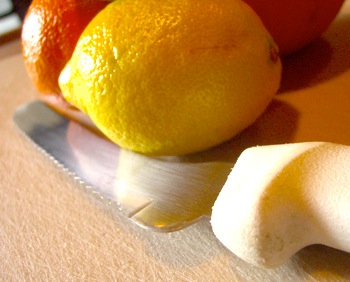
But for my money (and the safety of my hands), there’s no better knife than a nine-inch, serrated, offset-handled sandwich sword.
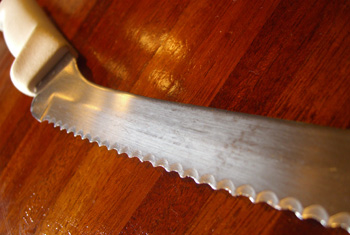
Forever used in sandwich shops and delis, the sandwich sword is the neophyte’s knife that can turn on a dime in the right hands with just a little practice.
See, I don’t trust small knives. They’re vertically-challenged, which means that the height of their blades is short, so cutting requires razor-sharp precision. And that’s something I don’t always have during the middle of a busy Friday night, if ever. Let’s face it, wet hands and a sharp knife are kind of a scary combo. And the offset silicone handle is easy on the the hands and knuckles.
Another reason I prefer my knife to theirs it that a four-inch blade doesn’t work well with larger items like pineapples and grapefruits, so those fruits end up coming out looking butchered. And for the few that have ever worked with me, you know how particular I am about my garnishes. Sloppy angles, dented fruit and torn peels are a thing of the past with the old sandwich sword. My garnish trays are always full of fresh fruit with crisp, clean edges.
Citrus peels are often thick and sometimes full of grit, which will dull a blade quickly. But my sandwich sword is serrated, so it keeps a usable edge for longer. I can still straighten the edge with a steel I keep behind the bar, but once it’s passed a certain point I don’t mind throwing it out and getting a fresh one. They’re only ten bucks.
Am I the only one out there who uses a monster like this? Let me know in the comments.

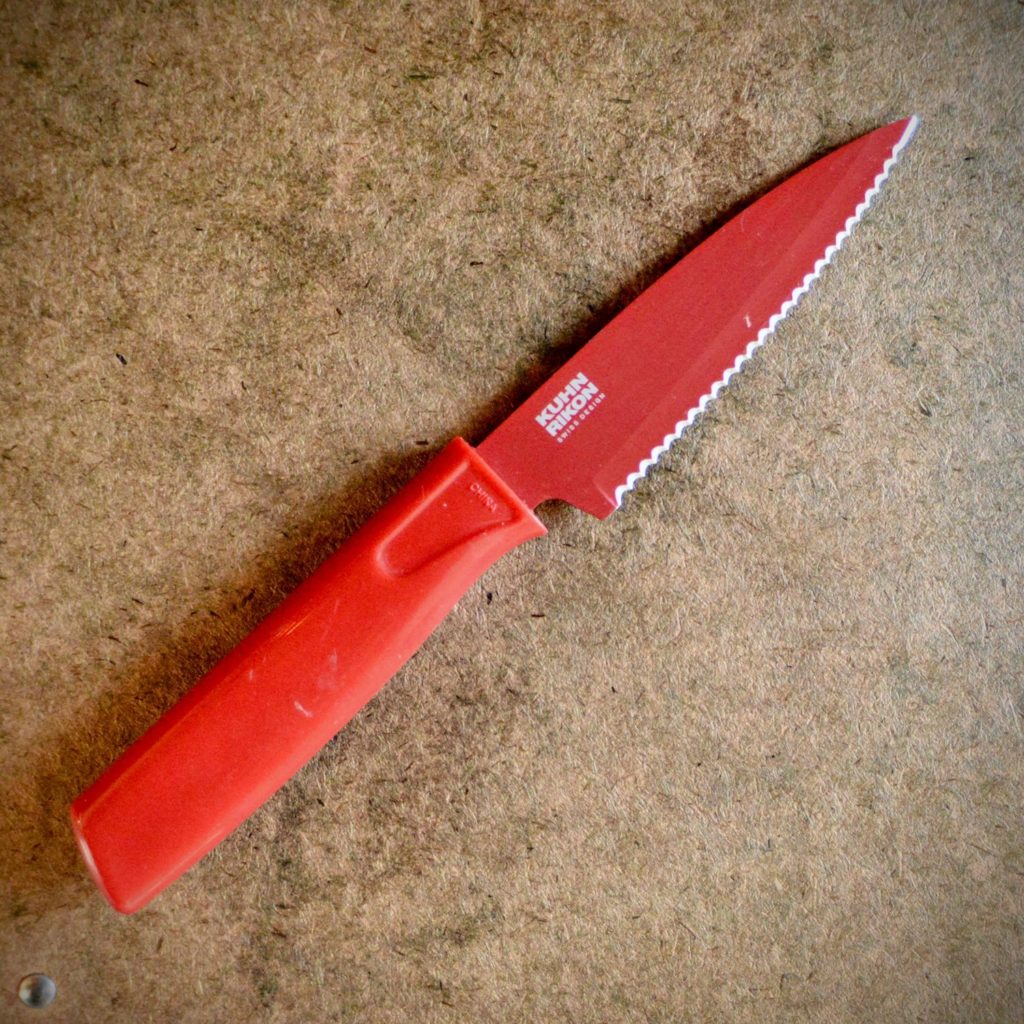
I recently bought one of the Kuhn Rikon paring knives for home use and have been very happy with it so far. Very sharp, and comes with a convenient plastic sheath for easy storage/portability. If you don’t mind a small knife, it’s a good option. Also just ten bucks.
You & I must think alike! I’ve been using a nine-inch serrated bread knife for all of my fruit cutting and garnish work for years! The serrated edge not only helps start the cut, but the extra length helps do it quicker.
Being a home bartender rather than a professional one, I have the advantage of using my assortment of cooking knives when making garnishes or cutting up fruit.
That said, I’m a stickler about having good, sharp knives because I like my fingers where they are. In general, paring knives are great for scoring or seeding, but I generally turn to my chef or bread knives when I need to do anything else.
I’ve largely abandoned paring knives in favor of the knife I use for 95% of all my cooking needs, a Wusthof Gran Prix 6.5″ Santoku (http://tinyurl.com/4tb52d), since it can do everything a paring knife can do and more, with equal agility. Nice not-too-big-not-too-small size, too, at least for my gargantuan circus-freak hands. More precision than a serrated blade can provide, too. I think you’d dig it.
For me, I prefer a ceramic Santoku knife with a 6 inch blade. These things are ultra sharp and really do a great job on lemons/limes and even a pineapple because they are so sharp.
The one problem is that ceramic blades can chip if bashed against a cutting board.
Lesson learned: Don’t lend the knife to other bartenders.
21 Apr 2008 at 12:51 pm 7. John Claude
I’m in full agreement with Jeffrey here. I’ve used these giant knives for cutting fruit in the last two places I’ve worked and they’re a godsend. Last thing I need is some tiny blade slipping and slicing into my hand in the middle of a rush.
Ryan and Jacob, thanks for the links, I will have to do some investigating.
Jimmy, suck it.
Darcy, I’m intrigued but I always end up sharing with the rest of the bar staff, so I worry about ceramic blades as a usable option for my bar. But I might just take your advice for the home bar…
21 Apr 2008 at 2:31 pm 9. Dan
The versatile santoku knife does just fine for me. I use a 6″ blade.
21 Apr 2008 at 7:41 pm 10. sam
These are the only knives we ever had when I used to tend bar. Probably because they’re cheap at restaurant supply stores? They are easy to use when you’re cutting forty pounds of lemons.
I use a 6″ ceramic knife for cutting limes, etc. I like the additional size over the paring knife I used to keep in the bar, but it has a much bigger advantage.
It is SHARP. and it stays that way. I’m one of those who are sharp nazis. If your blade is really sharp, it does more for control and safety than size.
22 Apr 2008 at 4:19 am 13. Brutis
Jeff,
As a left hander, a serrated knife just doesn’t work for me. I do watch others in the bar using the bread knife with ease but it is no good for me, as I always end up with crooked or bad cuts!
I use a 12″ Victorinox Chefs knife. I give it a good run on the steel before service every Friday night and it lasts all week. Had it for about 12 months now, only cost me $30(AUD). I will never go back.
I also bought the 6″ pairing knife for the more delicate jobs.
Cheers!
22 Apr 2008 at 10:41 am 14. John Claude
That 6.5″ Wusthoff that was linked is pretty nice looking. I may have to invest in that. I have a smaller Wusthoff for garnishing that I love.
My all-time favorite knife is a 7-inch Chinese vegetable knife.
It’s a no-name brand I got at Target for 15 bucks and it works like a charm. For a cheapo knife it’s amazingly well-balanced and incredibly comfortable in the hand. I use it for 99% of my kitchen cutting tasks.
I can’t imagine going back to a paring knife for my garnishes. It whacks up limes, lemons, pineapples and other stuff without me having to muscle it. I do have to sharpen it fairly frequently, but I imagine a “real” brand-name knife will hold an edge longer.
With all the discussion on knives, I thought it might make a great topic to discuss our favourite barware.
What’s your shaker of choice? Who makes the best hawthorne strainer, jigger, barspoon, etc…?
If you were to put together the ultimate “everything-you-need” bar kit, what would it consist of?
Blair
24 Apr 2008 at 10:47 am 17. Dan
I love my Rosle Boston Shaker and bar accessories :)
25 Apr 2008 at 6:18 am 18. Kelsey Crenshaw
Try going through 2 cases of limes between 2 tenders in 2 hours (after you’ve gone through prepped fruit).I call it more-jitos and more-jito madness!
I worked in a bar for almost three years that used a hamilton beach juicer and nothing from a can or bottle for juice. J’s knife recommendation is spot on..I can not believe the accuracy and speed you also have the best length of handle and blade…I still have all my fingers.
Glad to see I’m not the only one who slings one of these things about (though I occasionally use a 6″ santoku as well)…
I got into food & drink working in a high-end deli - the bread knife is indeed a suprisingly-marvelous tool.
Cheers!
06 May 2008 at 1:58 pm 22. Tiare
Agree on the serrated bread knife.
During my past years in the kitchens i`ve experienced a few of these “tiny blade slipping and slicing into my hand in the middle of a rush” things and i`m more careful now.
The bread knife does a good job and the serrated edge helps start the cut nicely.
15 May 2008 at 9:19 am 23. Mark
I just use one of our restaurants old school steak knives that has a serated blade the full length of the blade. Its about six inches and works perfectly
A cool experiment to show the way serrated knives affect foods is to dice 2 peppers. One with an off set serrated slicer and one with a sharp standard santuko or chefs knife. Sweat the two in separate pans and watch the juices run out of the serrated pepper. As the serrated knife passes through the fruit or vegetable it makes lots of small tears that cause this weeping during cooking, making it a pour choice for anything that will be cooked, but an excellent choice for foods served raw, like garnishes. As the serrated knife passes trough your lime you are exposing more of the flesh which will pass on the intensity of aroma that is the reason you put the lime on the rim in the first place. And for juicing, your serrated knife has started the process for you!
In professional kitchens, everyone has their own knives and other small tools and woe betide anyone who touches, let alone uses, another’s knives. It seems to me this is an excellent model for bars, especially as you begin to find more professional “bar chefs.”
Cheers. - S
28 Apr 2009 at 8:28 am 27. Ryan
I’ll throw my vote for the 6.5″ santoku, the only time I’ve used a different knife in the past two years is when it’s dirty and I don’t feel like washing it. Holds an extremely sharp edge and I have never had trouble carving with it, plus the shape makes it naturally easy to avoid slipping and cutting yourself.
I absolutely hate it when someone sends me a box full of sex toys in the mail. Sure, it might sound like fun to some of you (you know who you are), but receiving a big box of free sex is much more trouble than it’s worth. Believe me. So I get a [...]
21 Apr 2008 at 7:32 am 1. Jacob
I recently bought one of the Kuhn Rikon paring knives for home use and have been very happy with it so far. Very sharp, and comes with a convenient plastic sheath for easy storage/portability. If you don’t mind a small knife, it’s a good option. Also just ten bucks.
http://www.amazon.com/Kuhn-Rikon-2814-Non-stick-Paring/dp/B000GZA38I/ref=pd_bxgy_k_text_b
Thanks for the sandwich knife suggestion.
21 Apr 2008 at 8:21 am 2. blair frodelius
Jeff,
You & I must think alike! I’ve been using a nine-inch serrated bread knife for all of my fruit cutting and garnish work for years! The serrated edge not only helps start the cut, but the extra length helps do it quicker.
Blair
21 Apr 2008 at 9:09 am 3. Marleigh
Being a home bartender rather than a professional one, I have the advantage of using my assortment of cooking knives when making garnishes or cutting up fruit.
That said, I’m a stickler about having good, sharp knives because I like my fingers where they are. In general, paring knives are great for scoring or seeding, but I generally turn to my chef or bread knives when I need to do anything else.
21 Apr 2008 at 9:44 am 4. jimmy
overcompensating?
21 Apr 2008 at 10:51 am 5. Ryan Stotz
I’ve largely abandoned paring knives in favor of the knife I use for 95% of all my cooking needs, a Wusthof Gran Prix 6.5″ Santoku (http://tinyurl.com/4tb52d), since it can do everything a paring knife can do and more, with equal agility. Nice not-too-big-not-too-small size, too, at least for my gargantuan circus-freak hands. More precision than a serrated blade can provide, too. I think you’d dig it.
21 Apr 2008 at 11:17 am 6. Darcy
For me, I prefer a ceramic Santoku knife with a 6 inch blade. These things are ultra sharp and really do a great job on lemons/limes and even a pineapple because they are so sharp.
The one problem is that ceramic blades can chip if bashed against a cutting board.
Lesson learned: Don’t lend the knife to other bartenders.
21 Apr 2008 at 12:51 pm 7. John Claude
I’m in full agreement with Jeffrey here. I’ve used these giant knives for cutting fruit in the last two places I’ve worked and they’re a godsend. Last thing I need is some tiny blade slipping and slicing into my hand in the middle of a rush.
21 Apr 2008 at 1:13 pm 8. Jeffrey Morgenthaler
Ryan and Jacob, thanks for the links, I will have to do some investigating.
Jimmy, suck it.
Darcy, I’m intrigued but I always end up sharing with the rest of the bar staff, so I worry about ceramic blades as a usable option for my bar. But I might just take your advice for the home bar…
21 Apr 2008 at 2:31 pm 9. Dan
The versatile santoku knife does just fine for me. I use a 6″ blade.
21 Apr 2008 at 7:41 pm 10. sam
These are the only knives we ever had when I used to tend bar. Probably because they’re cheap at restaurant supply stores? They are easy to use when you’re cutting forty pounds of lemons.
21 Apr 2008 at 7:55 pm 11. Jeffrey Morgenthaler
Yeah, I do wonder how long a non-scalloped knife will hold an edge when confronted by a 40-pound box of limes.
22 Apr 2008 at 4:08 am 12. Doug Winship
I use a 6″ ceramic knife for cutting limes, etc. I like the additional size over the paring knife I used to keep in the bar, but it has a much bigger advantage.
It is SHARP. and it stays that way. I’m one of those who are sharp nazis. If your blade is really sharp, it does more for control and safety than size.
22 Apr 2008 at 4:19 am 13. Brutis
Jeff,
As a left hander, a serrated knife just doesn’t work for me. I do watch others in the bar using the bread knife with ease but it is no good for me, as I always end up with crooked or bad cuts!
I use a 12″ Victorinox Chefs knife. I give it a good run on the steel before service every Friday night and it lasts all week. Had it for about 12 months now, only cost me $30(AUD). I will never go back.
I also bought the 6″ pairing knife for the more delicate jobs.
Cheers!
22 Apr 2008 at 10:41 am 14. John Claude
That 6.5″ Wusthoff that was linked is pretty nice looking. I may have to invest in that. I have a smaller Wusthoff for garnishing that I love.
22 Apr 2008 at 11:24 am 15. Dr. Bamboo
My all-time favorite knife is a 7-inch Chinese vegetable knife.
It’s a no-name brand I got at Target for 15 bucks and it works like a charm. For a cheapo knife it’s amazingly well-balanced and incredibly comfortable in the hand. I use it for 99% of my kitchen cutting tasks.
I can’t imagine going back to a paring knife for my garnishes. It whacks up limes, lemons, pineapples and other stuff without me having to muscle it. I do have to sharpen it fairly frequently, but I imagine a “real” brand-name knife will hold an edge longer.
It looks similar to this:
http://www.cooking.com/products/shprodde.asp?SKU=198393
23 Apr 2008 at 7:48 am 16. blair frodelius
Jeff,
With all the discussion on knives, I thought it might make a great topic to discuss our favourite barware.
What’s your shaker of choice? Who makes the best hawthorne strainer, jigger, barspoon, etc…?
If you were to put together the ultimate “everything-you-need” bar kit, what would it consist of?
Blair
24 Apr 2008 at 10:47 am 17. Dan
I love my Rosle Boston Shaker and bar accessories :)
25 Apr 2008 at 6:18 am 18. Kelsey Crenshaw
Try going through 2 cases of limes between 2 tenders in 2 hours (after you’ve gone through prepped fruit).I call it more-jitos and more-jito madness!
I worked in a bar for almost three years that used a hamilton beach juicer and nothing from a can or bottle for juice. J’s knife recommendation is spot on..I can not believe the accuracy and speed you also have the best length of handle and blade…I still have all my fingers.
27 Apr 2008 at 6:51 pm 19. Dominik MJ
A very long blade just doesn’t work out for me…
I am more with Darcy - take out your ceramic knife and just watch it carefully.
I tell my bartender, that there is a serious curse on the knife - if the touch it, the bad bartender spirits are obsessing them…
I also wrote last year about my perfect knife…
check this out…
http://web.mac.com/opinionatedalchemist/the_opinionated_alchemist/the_opinionated_bar-log/Entries/2007/10/8_bar-tool-mania_I_-_bar_knives!.html
28 Apr 2008 at 4:00 am 20. Dominik MJ
…sorry and now the right link!
http://web.mac.com/opinionatedalchemist/the_opinionated_alchemist/the_opinionated_bar-log/Entries/2007/10/8_bar-tool-mania_I_-_bar_knives!.html
(might need to be copied into address line)
01 May 2008 at 7:41 pm 21. Chris
Glad to see I’m not the only one who slings one of these things about (though I occasionally use a 6″ santoku as well)…
I got into food & drink working in a high-end deli - the bread knife is indeed a suprisingly-marvelous tool.
Cheers!
06 May 2008 at 1:58 pm 22. Tiare
Agree on the serrated bread knife.
During my past years in the kitchens i`ve experienced a few of these “tiny blade slipping and slicing into my hand in the middle of a rush” things and i`m more careful now.
The bread knife does a good job and the serrated edge helps start the cut nicely.
15 May 2008 at 9:19 am 23. Mark
I just use one of our restaurants old school steak knives that has a serated blade the full length of the blade. Its about six inches and works perfectly
04 Jul 2008 at 8:04 am 24. Brendan
A cool experiment to show the way serrated knives affect foods is to dice 2 peppers. One with an off set serrated slicer and one with a sharp standard santuko or chefs knife. Sweat the two in separate pans and watch the juices run out of the serrated pepper. As the serrated knife passes through the fruit or vegetable it makes lots of small tears that cause this weeping during cooking, making it a pour choice for anything that will be cooked, but an excellent choice for foods served raw, like garnishes. As the serrated knife passes trough your lime you are exposing more of the flesh which will pass on the intensity of aroma that is the reason you put the lime on the rim in the first place. And for juicing, your serrated knife has started the process for you!
08 Jul 2008 at 10:51 am 25. Jeffrey Morgenthaler
That’s some great information, chef Brendan, thanks for writing in!
23 Jul 2008 at 11:31 am 26. The Scribe
In professional kitchens, everyone has their own knives and other small tools and woe betide anyone who touches, let alone uses, another’s knives. It seems to me this is an excellent model for bars, especially as you begin to find more professional “bar chefs.”
Cheers. - S
28 Apr 2009 at 8:28 am 27. Ryan
I’ll throw my vote for the 6.5″ santoku, the only time I’ve used a different knife in the past two years is when it’s dirty and I don’t feel like washing it. Holds an extremely sharp edge and I have never had trouble carving with it, plus the shape makes it naturally easy to avoid slipping and cutting yourself.