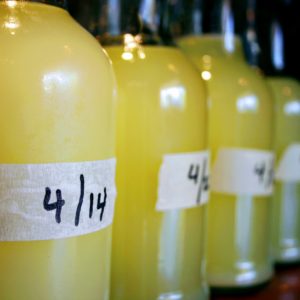
Inspired by a visit to see Tony Conigliaro at the unnamed bar at 69 Colebrooke Row in London last fall, where Manhattans are aged in glass vessels to sublime and subtle effect, the barrel aged cocktails I’ve been serving at Clyde Common this year are a decidedly American curiosity.
The rub of aging cocktails in a glass bottle is that the whole premise is built upon subtlety, as we know that spirits aged in glass or steel do so at an unremarkable pace. Being from the United States, where – as everyone is aware – bigger equals better, I pondered the following question: what if you could prepare a large batch of a single, spirit-driven cocktail and age it in a used oak barrel?
A hundred some-odd dollars in liquor later, I was nervously pouring a gallon of pre-batched rye Manhattans into a small, used oak cask whose previous contents were a gallon Madeira wine. I plugged the barrel and sat back in anxious anticipation; if the experiment was a success I’d have a delicious cocktail to share at the bar – if it was a failure then I’d be pouring the restaurant’s money down the floor drain.
Over the next several weeks I popped open the barrel to test my little concoction until I stumbled upon the magic mark at five-to-six weeks. And there it was, lying beautifully on the the finish: a soft blend of oak, wine, caramel and char. That first batch sold out in a matter of days and I was left with a compelling need to push the process even further.
Now, three gallons of Negroni might not be practical for the home enthusiast, but the average bar or restaurant should be able to afford that sort of quantity quite easily. For those of you trying this at home, try searching the internet for one-gallon charred oak casks (stay away from the fancy lacquered kind meant for display in dens and 1980s wine bars) and be sure to let us know what you find in the comments section below.
We procured a small number of used whiskey casks from the Tuthilltown distillery and proceeded to fill them with a large batch of Negronis; and that’s when the magic of barrel aged cocktails grabbed our attention. After six weeks in the bourbon barrel, our Negroni emerged a rare beauty. The sweet vermouth so slightly oxidized, the color paler and rosier than the original, the mid-palate softly mingled with whiskey, the finish long and lingering with oak tannins. We knew we were on to something unique and immediately made plans to take the cask aging program to the next level.
Negronis are now prepared in five-gallon batches and poured into multiple bourbon barrels. Robert Hess’ ubiquitous Trident cocktail is currently resting inside single-malt barrels. The El Presidente (à laMatt Robold), Deshlers, Remember the Maines, they’re all receiving the oaked treatment in a little storage room in the basement of the restaurant that I refer to as my “office”.
Once the cocktail is aged long enough for my taste, I then drain the bottle, straining out any charred bits of wood, and bottle the contents for use by my bartenders. To order, the cocktail is then measured out and poured over ice in a mixing glass, stirred, strained into a cocktail glass, and then garnished with the appropriate garnish. It’s quick and simple, as all of the real work has already been done by the barrel.
Anyway, on to the recipes. As simple as it seems to do, I figured not everyone is going to want to do the math to get started on some of these recipes, so here are a few I’ve figured out:
Negroni
Makes Three Gallons
128 oz (approximately five 750ml bottles) dry gin
128 oz sweet vermouth
128 oz Campari
Stir ingredients together (without ice) and pour into a three-gallon oak barrel. Let rest for five to seven weeks and pour into glass bottles until ready to serve.
Manhattan
Makes Three Gallons
256 oz (approximately ten 750ml bottles) rye whiskey
128 oz (approximately five 750ml bottles) sweet vermouth
7 oz Angostura bitters
Stir ingredients together (without ice) and pour into a three-gallon oak barrel (I prefer a barrel that has previously stored sherry, Madeira, or port wine). Let rest for five to seven weeks and pour into glass bottles until ready to serve.
Trident
Makes Three Gallons
128 oz (approximately five 750ml bottles) aquavit
128 oz dry sherry
128 oz Cynar
7 oz peach bitters
Stir ingredients together (without ice) and pour into a three-gallon oak barrel (I prefer a used single malt barrel). Let rest for five to seven weeks and pour into glass bottles until ready to serve.
Feel free to leave any questions in the comments section below.
My problem with homemade tonic water has always been a flavor profile that was too esoteric for the general audience. This recipe takes some of the positive qualities people have come to understand from commercial tonic water and updated them with fresh ingredients.
One question I'm often asked is "Do you have any drink-related book recommendations?" Well, funny you should ask, I've compiled a list of the ten books every professional bartender or home mixologist should own. I keep every one of these close at hand and have read most of them several times. I suggest you do the same.
The problem with living in Oregon is the absence of little wooden shacks by the sea that sell cases of fresh ginger beer stacked on back porches. But with some readily-available ingredients, a recipe I've been revising for several years - and a few free minutes - I can easily transport myself to a little fishing boat on the ocean as I sip a Dark and Stormy made with fresh, house-made ginger beer.
It's always mojito season somewhere, so this advice is timely in your area about half the year. Wether you're making them or simply enjoying them, this advice will help you look like a pro in no time at all.
The flavors of the Richmond Gimlet are imbued with sunshine. Fresh mint mingling with the herbaceousness of gin and the tartness of lime have made this drink a Eugene classic for many years now.
You'll get a lot of snarky advice on this site about how to make a proper drink, but if you ever need to know what not to do, this is the video for you.
Not to be confused with the Spanish wine-and-fruit-based alcoholic beverage sangria, sangrita (meaning "little blood") is a traditional accompaniment to a tequila served completo; a non-alcoholic sipper that cleanses the palate between fiery doses of agave.
The world of booze can be mystifying to people that don't work in bars or around alcohol all the time. I hear a lot of assumptions about the industry I'm in that are - much like 90% of what you hear in bars - completely false. Here are a few you've probably heard yourself.
The debate rages on: Should we try to look cool and crack open the Boston shaker or be tidy professionals and use the Hawthorne strainer the way God intended? Be sure to leave your two cents in the comments section.
The traditional garnish for a Pisco Sour is a couple of drops of bitters in the foam, but I've never been particularly impressed with the way these few paltry drops of bitters sat in their little egg-white mattress and didn't play along with the rest of the drink. I envisioned a Pisco Sour with a uniformly-distributed bitters-scorched foam: slightly crisp as the fire burnt the sugars, and slightly warm as the foam insulated the rest of the frosty cocktail from the heat. A pisco creme brulée in a glass!
I get so many visitors looking for tips on how to write a bartending resume that I thought I should finally post a tutorial on how to write your own. Click the headline to read more.
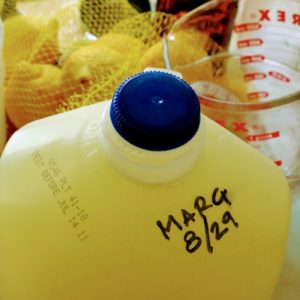
I always love showing up to a party with a gallon jug of pre-mixed margaritas, so I've decided to share my recipe. This margarita recipe is the perfect blend of strong, sweet, and sour. But be warned: this recipe packs a serious punch.
There isn't much I can say about this video that hasn't been said already. If you've read anything I've written about cocktails, you'll understand why this video symbolizes everything wrong with the state of bartending in America today. Watch and learn, but be warned: this one isn't for the feint of heart.
About Me
My name is Jeff Morgenthaler and I'm the head bartender at Clyde Common in Portland, Oregon.
I've been tending bar since 1996 and writing about it since 2004. Mixing drinks has become something of a passion for me in recent years, and I strive to elevate the experience of having a drink from something mundane to something more culinary.
The writing I do here is intended as a work in progress. My recipes are like my opinions: they are constantly being revised and refined as I work them through my mind and my fingers. Comments and participation are encouraged, so please don't feel the need to tread lightly here.
With my recent move to Portland and consequent adjustment to a new work environment, new living situation and new selection of great bars and restaurants to explore, I’ve been a little lax on the new drink recipes.
Fortunately I have my cruel taskmasters at Boca Loca Cachaça to keep me toiling away, day and night, churning out recipe after recipe using their incredible product.
If you haven’t experienced Boca Loca yet, I urge you to give it a try as I firmly feel it is the finest cachaça available on the market today. The spirit is light and fresh, and free from a lot of the oiliness and heavy smoke you’ll find in other – sometimes inferior – cachaças available out there. There is grassiness, big stone fruit, some white pepper and a very light honey finish. Boca Loca is a beautiful product and it’s a pleasure to work with.
So for the spring I set about creating a series of cocktails that showcased the cachaça in a different way. This is my first entry.
Inspired in part by a gorgeous cocktail created by my good friend Gonçalo de Souza Monteiro, the Comte de Sureau, I turned the drink around and twisted the proportions to highlight the cachaça, and then finished the whole thing with a little lemon oil. It’s simple, petite, and a beautiful thing to sip on.
1½ oz Boca Loca cachaça
¾ oz Aperol
½ oz St. Germain elderflower liqueur
Stir ingredients with cracked ice and strain into a small chilled cocktail coupe. Garnish with a generous twist of lemon.
As soon as I get my fingers on Aperol I’ll have to give this one a try. Love cachaca and St. Germain is among my favorites. Thanks for your take on the Boca Loca.
Jeffery ~ I haven’t bought a bottle of liquor since Christmas, but I’ve got all these. We’ve been working through the liquor cabinet(s) like mad. Once I shake off the grips of my current gin fizz obsession, the Caneflower is coming up.
Curse you, Morgenthaler! Now I need to find not only a bottle of Boca Loca, but I have to replenish my bottle of Aperol. I’m going to need a second income thanks to you.
Settle down, Frane. Boca Loca is really affordable – especially considering the quality. As for replenishing the Aperol, the good news there is that a little can go a long way.
Now that you’re all Portland-y and everything . . . have you seen it on the shelf? I do see it on the OLCC list. Pearl? That’s where I found the Aperol.
02 Mar 2009 at 6:21 pm 9. John Claude
Wow, yeah, I’m out of it. Sugarcane. I am really surprised that name hasn’t been used yet.
Great recipe! i like every sinlge thing in it, but really irritating is that i cannot find Boca Loca here, i really do like cachaca so one way or another there`s got to be a way to find it sooner or later!
03 Mar 2009 at 7:28 am 11. Kathryn
Welcome to Portland. You were in my restaurant on Sunday having brunch. The business card is a classy touch.
03 Mar 2009 at 8:45 am 12. Robin
The Caneflower sounds lovely. I already love Boca Loca caipirinhas, but this sounds truly fresh and spring-y!
03 Mar 2009 at 8:47 am 13. JD
Is Campari an acceptable substitute (for the Aperol) for those of us with less access to quality liquor?
JD – Unfortunately Campari and Aperol are not substitutes for one another. You’re just going to have to get your hands on a bottle of Aperol, my friend.
03 Mar 2009 at 10:29 am 15. TJ
Couldnt get my hands on a bottle of Boca Loca (cant wait to try it) so I improvised with LeBlon, dont know how much this altered the finished product though. I like the play between the Aperol and the St. Germain quite a bit… Delicious!
I’m disappointed to hear that my personal recommendation isn’t enough for you, Ciaran. But I’m willing to stake my (cough) fine reputation on the matter.
Pearl did, in fact, have Boca Loca, and it’s cheap. They did not have Aperol, but I had a bit left at home. The Boca Loca doesn’t taste anything at all like rum, which surprised me. In fact, it smells like St Germaine, which is to say it smells like lychee.
The Caneflower(s), though, were as advertised. I do love a simple, tasty cocktail.
So happy to hear other cocktailians liking Boca Loca and better yet that you are all finding it! Jeff has created many a great Boca Loca cocktail for us so if in need of other ideas check out our website for a nice list including some other new drinks for spring. Also noteworthy is a complete list of how to tell a good cachaca from a bad one. Try it out with whatever cachaca you have in your bar and see how it fares.
24 Apr 2009 at 10:56 am 21. Jeremy
As Aperol and St Germain have become two of my favorite liquers, I was wondering if anyone had other suggestions for combining the two in a cocktail.
15 May 2009 at 5:42 pm 22. Mark
Jeremy,
As it happens, my wife had me make a cocktail from her Martha Stewart “Living” magazine that one of her minions came up with called the Gemini as follows:
2 oz grapefruit juice
1.5 oz St. Germain
1 oz Vodka
Top with Prosecco (which I did not have)
It was ok. A little heavy on the grapefruit juice.
I thought I could do better and since I just walked in the door with a bottle of Aperol I came up with this:
1.5 oz grapefruit juice
1.5 oz Gin
.5 oz Aperol
.25 oz St. Germain (it may have been a smidge more than that)
I absolutely hate it when someone sends me a box full of sex toys in the mail. Sure, it might sound like fun to some of you (you know who you are), but receiving a big box of free sex is much more trouble than it’s worth. Believe me. So I get a [...]
02 Mar 2009 at 3:38 pm 1. The Intoxicologist
As soon as I get my fingers on Aperol I’ll have to give this one a try. Love cachaca and St. Germain is among my favorites. Thanks for your take on the Boca Loca.
02 Mar 2009 at 3:46 pm 2. John Claude
Did you give it a name yet?
02 Mar 2009 at 3:51 pm 3. Jeffrey Morgenthaler
Intoxicologist – Let me know what you think once you get your fingers on some Aperol!
And John Claude – Yes, it’s the Caneflower. See above ;)
02 Mar 2009 at 4:17 pm 4. rowley
Jeffery ~ I haven’t bought a bottle of liquor since Christmas, but I’ve got all these. We’ve been working through the liquor cabinet(s) like mad. Once I shake off the grips of my current gin fizz obsession, the Caneflower is coming up.
02 Mar 2009 at 4:18 pm 5. Jeffrey Morgenthaler
Matt – That’s terrific, I can’t wait to hear what you think about the drink.
02 Mar 2009 at 4:46 pm 6. Jeff Frane
Curse you, Morgenthaler! Now I need to find not only a bottle of Boca Loca, but I have to replenish my bottle of Aperol. I’m going to need a second income thanks to you.
02 Mar 2009 at 4:52 pm 7. Jeffrey Morgenthaler
Settle down, Frane. Boca Loca is really affordable – especially considering the quality. As for replenishing the Aperol, the good news there is that a little can go a long way.
02 Mar 2009 at 4:59 pm 8. Jeff Frane
Now that you’re all Portland-y and everything . . . have you seen it on the shelf? I do see it on the OLCC list. Pearl? That’s where I found the Aperol.
02 Mar 2009 at 6:21 pm 9. John Claude
Wow, yeah, I’m out of it. Sugarcane. I am really surprised that name hasn’t been used yet.
03 Mar 2009 at 5:00 am 10. Tiare
Great recipe! i like every sinlge thing in it, but really irritating is that i cannot find Boca Loca here, i really do like cachaca so one way or another there`s got to be a way to find it sooner or later!
03 Mar 2009 at 7:28 am 11. Kathryn
Welcome to Portland. You were in my restaurant on Sunday having brunch. The business card is a classy touch.
03 Mar 2009 at 8:45 am 12. Robin
The Caneflower sounds lovely. I already love Boca Loca caipirinhas, but this sounds truly fresh and spring-y!
03 Mar 2009 at 8:47 am 13. JD
Is Campari an acceptable substitute (for the Aperol) for those of us with less access to quality liquor?
03 Mar 2009 at 9:04 am 14. Jeffrey Morgenthaler
JD – Unfortunately Campari and Aperol are not substitutes for one another. You’re just going to have to get your hands on a bottle of Aperol, my friend.
03 Mar 2009 at 10:29 am 15. TJ
Couldnt get my hands on a bottle of Boca Loca (cant wait to try it) so I improvised with LeBlon, dont know how much this altered the finished product though. I like the play between the Aperol and the St. Germain quite a bit… Delicious!
04 Mar 2009 at 6:56 pm 16. sylvan
Frane,
They do indeed have Boca Loca at Pearl, although it is not on their website. Picked up a bottle this afternoon.
Sylvan
06 Mar 2009 at 12:40 am 17. Ciaran
Hmm, they need to send me some samples so I too can feel it is the finest cachaca on the market.
06 Mar 2009 at 12:52 am 18. Jeffrey Morgenthaler
I’m disappointed to hear that my personal recommendation isn’t enough for you, Ciaran. But I’m willing to stake my (cough) fine reputation on the matter.
07 Mar 2009 at 11:04 am 19. Jeff Frane
Pearl did, in fact, have Boca Loca, and it’s cheap. They did not have Aperol, but I had a bit left at home. The Boca Loca doesn’t taste anything at all like rum, which surprised me. In fact, it smells like St Germaine, which is to say it smells like lychee.
The Caneflower(s), though, were as advertised. I do love a simple, tasty cocktail.
09 Mar 2009 at 4:17 pm 20. Rhonda
So happy to hear other cocktailians liking Boca Loca and better yet that you are all finding it! Jeff has created many a great Boca Loca cocktail for us so if in need of other ideas check out our website for a nice list including some other new drinks for spring. Also noteworthy is a complete list of how to tell a good cachaca from a bad one. Try it out with whatever cachaca you have in your bar and see how it fares.
24 Apr 2009 at 10:56 am 21. Jeremy
As Aperol and St Germain have become two of my favorite liquers, I was wondering if anyone had other suggestions for combining the two in a cocktail.
15 May 2009 at 5:42 pm 22. Mark
Jeremy,
As it happens, my wife had me make a cocktail from her Martha Stewart “Living” magazine that one of her minions came up with called the Gemini as follows:
2 oz grapefruit juice
1.5 oz St. Germain
1 oz Vodka
Top with Prosecco (which I did not have)
It was ok. A little heavy on the grapefruit juice.
I thought I could do better and since I just walked in the door with a bottle of Aperol I came up with this:
1.5 oz grapefruit juice
1.5 oz Gin
.5 oz Aperol
.25 oz St. Germain (it may have been a smidge more than that)
18 Sep 2009 at 3:55 pm 23. Chris
Great drink Jeff!
If you’re interested, I took a different spin on it (and a few others) when playing with Boca Loca:
http://rookielibations.blogspot.com/2009/09/highlighting-flavors.html
Cheers!