Contrary to what you may have heard, there’s more to my job than coming up with cool mezcal cocktails and bitching about having to write the schedule. At the end of the day, I’ve got to approach this career as a professional, with an eye on business. One of the more challenging parts of my job is designing a cocktail menu that is not only constantly fresh and on the cutting-edge, but also satisfies my two cruel taskmasters: our guests, and the guy who signs my paycheck.
My guests need to feel like they’re getting their money’s worth when they’re spending it at my bar. My restaurant needs to make a certain margin in order to pay purveyors, sign payroll, and maintain bills. The beauty of my job lies in that place in between, where guests are happy and the business is healthy. That place in between is where a successful bar lives.
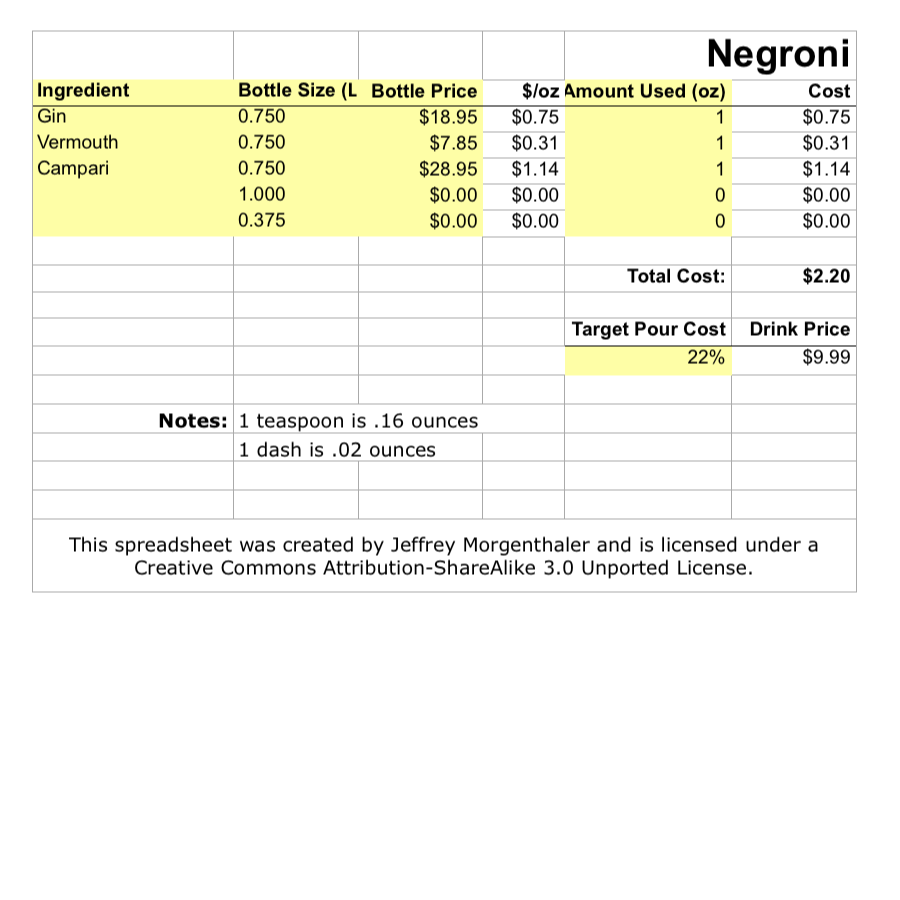
There is some simple math involved with pricing a cocktail. At the core, all you need to do is figure out how much the drink costs to make, and multiply by your targeted pour cost (if you’re unsure what this is, ask your boss or bookkeeper; the industry standard usually lies somewhere between 18% and 24%). It’s that easy, but it can get a little tricky sometimes. And so…

Download my fancy cocktail pricing calculator here.
Over the years I’ve developed a lot of spreadsheets to help make my job easier, and I’m going to share my simple cost calculator with you here today. All you need to plug into the formula are the following pieces of information: the cost and size of each bottle you’re pouring from, the cocktail recipe, and your target pour cost (all highlighted in yellow). The spreadsheet will calculate the rest.
Keep in mind that this is pricing at its most simple. The orchestration of a full cocktail menu can be a beautiful and complex thing, or it can be as simple as using the spreadsheet above. A simple list would have all of its drinks priced according to the formula I’ve given you. A complex list – like the one I currently curate – takes into account some other factors.
Let’s say, for argument’s sake, that you’ve got a two-drink cocktail menu, consisting of Drink A and Drink B.
Drink A is a complex cocktail that requires a little more attention from the bartender and uses some more obscure, expensive ingredients. It costs $10 but comes in at a 32% pour cost, but it’s designed appeal to a smaller segment of the customer base, and therefore you only sell ten of them a night. You make up for this with Drink B. Drink B costs $8 but comes in at a 17% pour cost. It’s appealing to a much larger audience, and therefore you sell 150 of them a night. Drink A is called a loss leader and it keeps your bar on the cutting edge, is there for the cocktail geeks, and helps stimulate the sale of Drink B by bringing in a constant flow of new guests to the bar. And the good news is that you can calculate all of these percentages with the spreadsheet I’m providing you.
I hope this spreadsheet helps and is of some help to at least a few of you out there. If there’s enough interest in this boring topic I’ll be happy to post some of my other formulas in the interest of being of service to my fellow bar managers everywhere.
Download my fancy cocktail pricing calculator (in metric) here.
As a last-minute addition, I’m including a metric version of this spreadsheet for our friends outside of the United States. I think I’ve converted everything successfully but if anyone notices any problems (yes, the default currency is in Euros but that shouldn’t have any bearing on the final numbers) please do let me know.



Thank you for the helpful guidance on how to price a cocktail menu. The insights into balancing cost, quality, and customer expectations were clear and practical. I appreciate the focus on maintaining profitability while still delivering value and creativity to guests. It’s a valuable resource that will definitely support smart, strategic menu planning.
Its not overpriced you cheapscake you’re basically for the bartenders time to prepare it for you and sell you an experience and a good time
Hey Jeffrey, I just found your blog and I’ve found it to be wildly helpful to me. I look forward to reading your writing.
My question, do slushie machine cocktails typically have a lower pour cost percentage? We run at about 21% on most of our cocktails and the slushee recipes I’m coming up with are sitting closer to 12%. Is this reasonable to make up for the investment in equipment? Still providing 2.5 ounces of liquor per 8 oz pour and charging $7 per serving.
Thanks and cheers!
I don’t know if there’s a standard pour cost associated with the style of serving, I would imagine every scenario is different. I’ve never had to calculate the pour cost on a slushy drink before but it wouldn’t be any different than calculating it for a non-slushy drink. You can see my post on pour cost here.
Great info. I have been living in the Mountains of Montana for over 15 years and I am about to come down off of the Mountains and party. I am almost 70 and it’s time to let lose! Hello Jose’
That’s why I bartender
AT HOME.
Cheaper drinks and your not feeling the consequences of an over priced cocktail.
Thank you this helps a lot!!
I created a calculator based on a list of ingredients and cost/oz
=sumif(A4:A97,F4,C4:C97)*G4
Where A is the list of Liquors/Ingredients. F is a validation drop down list where you choose the ingredient. C is the Cost/Oz. You enter your Oz for the specific cocktail in G and the formula above is entered in H and calculates pour cost.
Create a row per ingredient and then you sum up your rows for total cocktail cost.
Absolutely love this site. It is a fantastic tool for those who manage in the food and beverage service industry. BRAVO!!!!
Your a scalar and a gentleman! Thank you Jeffrey!
As an avid drinker and avid excel user (often at the same time), I can see how this tool could be handy. I imagine that the version you “curate” includes a comprehensive list of drinks/pricing/ingredents which is drawn upon by a drop down list that references vlookup/hlookup functions to pull the rest of the data. Bada-bing-bada-bang you have all the information on whatever drink you are curious about right at your fingertips. Another sheet that has information on total sales, and you know what the most profitable drink is (or would be if you knocked it up 10cents).
Great work.
Hi Jeffrey- thanks for the great post and glad to see you’re still responding to some of the questions. I was wondering how you factor in the cost of fresh juices and infused syrups , orgeat etc into the formula? Are these ingredients just factored into the overall pour cost, or is there a better way to incorporate other non-spirituous ingredients into the cost of a drink?
Ex: if 1 lemon costs $0.40 and produces 1/2oz-3/4oz of juice and the drink requires 3/4 oz lemon juice would this add on only $0.20 to the overall cost?
Thanks!
Yes. Exactly.
Ah. I overlooked the fact that the bottle sizes are based on liter measurements. Thanks!
Jake;
The 33.814023 is the ounce amount in a Liter sized bottle of booze. If you’re using a 750ml in the formula, you need to multiply it by the Liter amount in order to get the correct cost. That way you get the correct cost by ounce out of your bottles.
There are 2 different charts, just figure which one works best for you. It’s a great spreadsheet to use!
How come in the price per ounce column, the bottle size is being multiplied by 33.814023? I get that based on the chart its trying to price based on an ml to oz conversion… but Google is telling me that 1oz is 29.5735ml.
For example, should the formula in D3 be =C3/(B3*29.5735) or am I totally overlooking something here?
Jake – Yeah, since American bottles are in metric and American recipes are in ounces, that little formula converts your bottle to ounces.
I think the formula in cell F12(the drink price after pour cost) should be =F9*(E12+1).
I’d love to know why you think that, Carlos.
I suck at formulas! I don’t know how to set one up and to download yours is all good, it’s not usable. Can you help me?
I love using the spreadsheet! It’s a great base to figure out your costs and now I can even add in my costs for syrups and garnishes to get a more definite feel of what each drink costs us! Thanks again!!
Jeffery,
For some reason, perhaps is my business school background, I find running an cost-effective bar program to be a part of the job I really enjoy. I was hoping you could post some of those other formulas you mentioned. I would like to maybe see things from a perspective I am not already using. Thanks for all you do for the betterment of the bartending community.
Thx mate for the calculator..
It will help a lot!
Cheers n keep it up!!!
Jeff, do you also try to include citrus and syrups into the cost of your drinks? I know juice varies from lemon to lemon or lime to lime, but is there any solid calculation you like to use?
Thanks again!
Thanks for the great post, and for being so generous with your advice.
Hello Jeff,
your blog is real source of inspiration for me, I own a molecular bar in Paris and try to respect your way.
But The link below do not work, could you please send me your pricing cocktail calculatar excel sheet by mail?
Thanks a lot.
Jérémy
The lab
07 rue saint sabin
Paris 7eme
Another wonderful post, Thank you very much Jeffrey
Thanks for this Jeff. I made a similar sheet but yours is far simpler.
My question is how to input costs and measurements for fruit. Berries for example.
I think another column with space for strawberries per case etc..
Thoughts?
Fantastic article! However I have a question. I’m being brought on as bar manager to repair a deeply damaged cocktail program of a restaurant. As such I will be swapping out almost all their liquors and replacing it with higher quality brands.
Is the restaurant’s old pour cost no longer relevant to me since I’m replacing the spirits? If so how do I go about calculating the new pour cost?
Thanks again, as this is one of the best cocktail blogs out there!
Payman
I love the idea of taking a more scientific look at the nuances of an industry that, to outsiders, might just look like a bunch of people throwing liquid into glasses and then going home.
Unrelatedly, “my two cruel taskmasters” was hilarious.
Jeff,
Figured it out. I screwed up my numerator and denominator. Not sure why it’s a tough concept for me to grasp, but I defintely enjoyed reading the post.
I was inspired and posted my own Excel spreadsheet for doing conversions and reductions for punches and other recipes that just weren’t written with the home enthusiast in mind.
I posted it here for those who’d like to check it out. http://zeitguys.us/?p=171
Even if we are using block ice which we have to transport about 300km to our bar….
Tomek – You should work that cost into the business plan to determine what you need your pour cost to be, not factor it in directly to the cost of each drink.
Anthonw- I don’t see how that isn’t making sense, I’d suggest taking another look at it.
Tomek – Yes, you’ve gone too far.
Nice stuff. Please keep it coming. Two questions regarding the costing:
1. Is adding the cost of ice going to far in your opinion.
2. If we give every customer a glass of water with their cocktail should we add that to our cost too?
What do you think?
So, if my pour cost is 99%, it means that for every dollar I charge customers, only one penny is left to cover labor, operating expenses, etc. Yet, from the calculator, if I specify a 99% pour cost, the calculator tells me I should only charge $2.22 for the Negroni that costs me $2.20 in raw materials.
Yet, if my pour cost is only 1%, the same cocktail should cost my customers $219.
I don’t work in a bar, but I find this calculator interesting. If my gross margin is 99% on a drink, it seems I should be charging less for the drink to maximize revenue at a certain price point. On the flip side, those drinks with a high pour cost should cost way more. I suppose if everything ranges between 15 and 25% all seems to work out well. However, the calculations in the spreadsheet don’t correspond to the comments in your post; at least not to my CPA mind. But like I said, I’ve never worked in a bar. To the extent you can explain this, I’d appreciate it.
Just starting to take over this role at work–very helpful explanation. We have a similar situation at our bar, balancing the menu with cocktails for enthusiasts vs. the theater and happy hour crowd. I look forward to more of these boring posts!
You know, you just gave me an idea … to do a calculator this is the reverse of this. I work with a lot of national accounts where the pricing is already set (i.e. they have a menu of $7.95 cocktails). And, knowing the pour cost, I plug everything in and know that the rum I use in that drink can’t be over x amount a bottle.
Hey Jeff!
Great post! Calculator is great. Glad to see you are posting again – yeah!
Jeff!!! I was afraid you’d left us!
Great post. I was just wondering about this my self, I don’t even work at a bar and found this really interesting. Now I can figure out what I’m spending each time I make myself a drink at my home bar.
Thanks again!
My dear Friend, this article is fantastic.
You’re the best cocktail teacher I ever been.
Thanks a lot!
Your friend of the far south
Federico Cuco
Buenos Aires Argentina
Thank you so much for being the “sharing” type of bartender. I know this was hours and hours of work that you are now kindly offering to your audience free of charge.
Hi Jeffrey, The spread sheet is great. Any tips on calculating dashes of bitters and fresh juices?
Michael – Thanks so much for the kind words. I’m glad I could help. I’ll be sure to show up and take advantage of the offer one day soon.
Jeffrey, a great thanks for taking the time from what I can only imagine is a hellish schedule to help out your fellow tenders. Like you wrote, “that place in between is where a successful bar lives;” that couldn’t be further from the truth. I can’t wait to share this with my bar manager (who sometimes would scoff at me for insisting on trusting me when it came to pricing… I was basically following a similar system as your spreadsheet). At this point in the game, I foresee a Jeff’s Guide to Bartending for Dummies in the future. You couldn’t make things easier to grasp if you tried. Cheers to you, and there’s a line of drinks waiting for you in Burlington, VT.
Thanks for the download Jeff!! I would love to see some more spreadsheets like this. In particular a larger Drink Price Calculator that one could have every drink(i.e. bottled beer, wine, shot of whiskey, etc.) a bar carries all on one spreadsheet. And for those iPhone users there is an app called “Drink Pricer” that is good for on the go when your calculating prices. The only problem with the app is the same reason I’d like to see a larger calculator, you can only calculate one drink/ingredient at a time.
This is really helpful. What an extraordinary post.
Congratulations on your TOTC nomination!
So simple, but extremely useful dear Jeffrey! This post reveals that your university studies 🙂
Thanks so very much. Take care.
Great post man. It’s a relief to see so many people thankful for you posting this.
Finally! I been dying to get my hands your speadsheets for a long time. Thanks for posting!
wow, thanks so much Jeffrey, I just became a bar manager of a disorganized place, last night was my first night and I was feeling really overwhelmed. This post makes me a lot more confident. and also thanks for the Remember the Maine I had last week!
Great post. Cocktails are cool and wonderful and all, but you have to make a reasonable profit. Wondering if you plan to make an app; we’d love to review it.
Nice to see that you’re posting again Jeffrey. This is one of the best cocktail blog out there. Why don’t you write more often ?
Love this post for the fact that it explains to the average bar patron that cost isn’t simply based off the price of the product. Energy costs, insurance costs, labor costs, etc. are often not considered by average consumers when they “judge” the cost of a cocktail. Wouldn’t mind seeing a post on your mezcal recipe though. Thanks for coming out of hibernation.
Thanks Jeff, and yes, I am very interested in this boring topic.
Paul – It’s the pour cost that you’re looking to come in at. If you’re unsure what this is, ask your boss or bookkeeper; the industry standard usually lies somewhere between 18% and 24%.
Can you please explain the target pour cost.what you mean ?thank you
Miss you Jeffrey !!!were you have been lost !!! Please blog more !! 🙂
Jeff, thanks for the great post – informative and interesting!
You mentioned the loss-leading aspect of some complex drinks, but do you also take into account the amount of time it takes to make the drink? We have a couple drinks on our menu that take longer to make than say, a daiquiri or Negroni, and consider it “OK” to price it slightly higher than comparable drinks of similar base cost but shorter execution time.
What do you think?
Jared – Of course it’s important to take that into account, but there’s really no way (or point) of quantifying that in this spreadsheet.
Well done. Real world info for real world Barkeepers.
Heather
In the world of pour cost, the lower the percentage, the better. So if you’ve got a 10% pour cost on a drink, that means it cost you $1 to sell a $10 cocktail.
So to answer your question, it depends on the drink and depends on the rest of the program. the most expensive loss leader I’ve had on my current list was around 35%, but that doesn’t mean much out of context.
Out of random interest, do you have a bottom percentage you’ll consider on a loss leader? If you thought it would be a good drink for publicity/traffic would you accept 15%? 10%?
I always wonder that when I see exotic ingredient $15 cocktails – because they can’t really be making much (any) profit on it.
THANK YOU! It’s stuff like this that reinforces for me that you are among the best, sir. I was just looking for this sort of thing for our new restaurant and i’ll be damned if this isn’t the simplest and most concise formula i’ve found out there so far. Keep up the good works and please blog more, we miss you!